Picture this. A journalist calls, sounding friendly, asking easy questions. Twenty minutes in, she asks one question that isn’t easy at all, and the founder, caught off guard, says something he didn’t mean to say quite like that. It runs exactly as spoken. Nobody edited it. Nobody softened it. That’s not a hypothetical; that’s how most bad press moments actually start, not with a hostile reporter out to get someone, but with an unprepared founder who walked into a conversation thinking it would go one way and got blindsided by how differently it actually went.
Here’s the thing nobody tells first-time founders before their first interview: a journalist isn’t your enemy, but they’re also not your friend taking notes for you. They have a story to write, a word count to fill, and an editor expecting something interesting. Every word a founder says is fair game unless it’s explicitly agreed to be off the record beforehand, and most founders don’t even know to ask for that. This is exactly the gap that MediagraphixPR’s media training is built to close, not by teaching founders to dodge questions, but by teaching them how to say what’s true in a way that actually serves them.
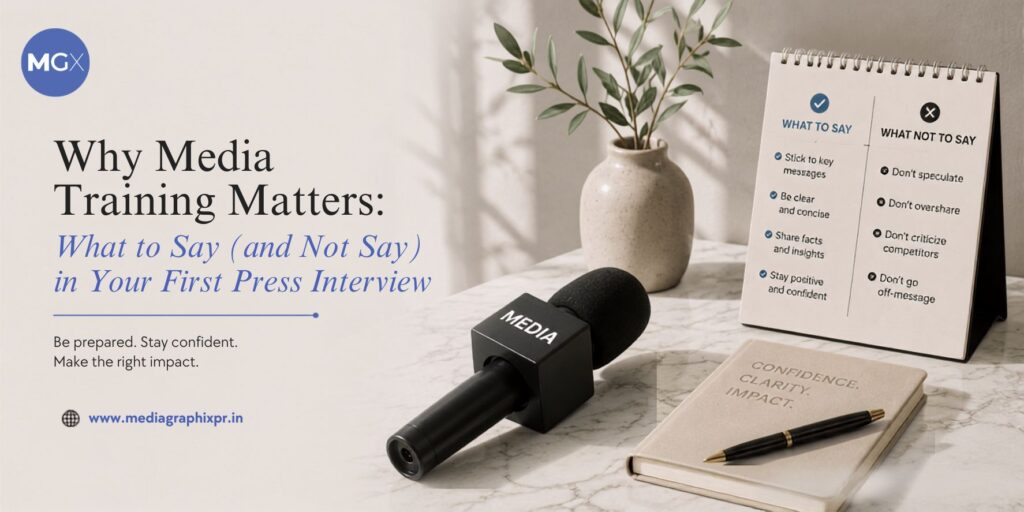
This piece breaks down what media training genuinely covers, why a founder’s first press interview is the single riskiest and highest-leverage media moment they’ll have, the specific mistakes that turn a good story into a bad one, and exactly what to say and what to avoid saying when a journalist finally has that microphone pointed your way.
It’s worth being honest about why this catches so many founders off guard. Most people’s only real reference point for what an interview feels like comes from watching celebrities or politicians on television, who are polished, rehearsed, and clearly media-trained. What they don’t see is the years of practice behind that composure. A founder walking into their first interview without any of that preparation is essentially performing a skill for the first time, live, with the transcript published immediately afterward. There’s no other professional situation quite like it, where a single unscripted moment gets permanently attached to a person’s name and searchable by anyone who ever looks them up again.
Why the First Interview Carries More Weight Than People Realize
A founder’s first big interview isn’t just one article. It’s the reference point every future journalist, investor, and employee will find when they research that person. Here’s why it matters more than most founders expect going in:
- It sets the narrative template. Once a quote runs, journalists writing follow-up stories tend to lean on it again and again, so a rough answer in that very first piece has a way of resurfacing in coverage for years afterward.
- It’s permanently indexed. Unlike a casual conversation, a published interview doesn’t fade. It sits on page one of a Google search for as long as anyone cares to look.
- It shapes how the founder is perceived internally too. Employees read press coverage of their own leadership. A founder who comes across confused or evasive in an interview quietly erodes internal confidence, not just external perception.
- There’s no do-over. A founder can clarify a statement afterward, but the original words are already published, and a correction rarely gets the same reach as the original piece.
- It becomes the reference document for future stories. Journalists writing follow-up pieces months or years later often pull directly from a founder’s earliest interviews to establish background, which means an early misstatement can quietly resurface in coverage the founder never anticipated.
None of this means founders should be terrified of interviews. It means they should walk in prepared, the way any experienced spokesperson does, instead of treating it as a casual chat that happens to be recorded.
What Media Training Actually Teaches (It’s Not What Most People Assume)
A lot of founders picture media training as being coached to give slick, scripted, robotic answers. That’s the opposite of what good training actually does. The best sessions don’t produce someone who sounds rehearsed, they produce someone who sounds exactly like themselves, just considerably harder to catch off guard.
➤ Message Discipline, Not Scripting
The goal isn’t memorizing exact sentences. It’s identifying the three or four core points that genuinely matter and practicing how to steer any question back to them naturally, without sounding evasive.
➤ Handling the Question Behind the Question
Sometimes a journalist’s question is really a door to a bigger story they’re chasing. Media training helps spokespeople spot what’s actually being probed underneath, so they can answer honestly without accidentally handing over more than they meant to.
➤ Staying Calm Under an Unexpected Angle
Interviews almost never go the way anyone scripted them in their head. What training really does is build the habit of pausing for a second, thinking it through, and answering on purpose, instead of just reacting the moment a hard question lands.
➤ Understanding What “Off the Record” Actually Means
Most founders assume saying “this part is off the record” after the fact protects them. It doesn’t, unless the journalist agreed to it before the statement was made. This single misunderstanding causes more damage than almost anything else in a first interview.
➤ Body Language and Tone for On-Camera Moments
On camera, how something comes across can matter just as much as the words themselves. That kind of composure, the pacing, the steadiness, isn’t something people just have. It gets built through actual practice.
➤ Recovering Gracefully From a Stumble
Everyone misspeaks occasionally, even seasoned spokespeople. Training builds the specific habit of catching a misstatement in real time and correcting it calmly, rather than either freezing or plowing ahead and hoping nobody notices.
The Chain Reaction of an Unprepared Interview
It helps to see exactly how one unprepared moment turns into a lasting problem. Here’s the pattern that plays out more often than founders expect:
Founder agrees to an interview without preparation
↓
Journalist asks a tough or unexpected question
↓
Founder answers off the cuff, unclearly or overly candid
↓
Quote gets published exactly as said, out of the intended context
↓
Story spreads through social shares and follow-up coverage
↓
Investors, customers, and employees encounter the quote independently
↓
Founder spends the following weeks doing damage control instead of building the business
Compare that to a founder who’s been through even a single structured training session. The same tough question gets a considered, honest, on-message answer, and the story that runs actually reflects what the founder meant to say in the first place. The difference isn’t talent. It’s preparation.
It’s also worth noting that this chain reaction doesn’t always start with an aggressive or “gotcha” question. Sometimes it’s the opposite, a friendly, open-ended question like “so what’s the vision here?” that catches an unprepared founder off guard precisely because it feels harmless. Without a clear sense of the two or three points they actually want to land, founders often ramble their way into a tangent that becomes the headline, simply because there was nothing anchoring the answer.
What to Say in a First Press Interview
| Situation | What Works |
|---|---|
| A question outside your area of expertise | Say so honestly, and redirect to what you do know with confidence, rather than guessing |
| A pointed or aggressive question | Stay calm, acknowledge the question directly, then answer with facts rather than defensiveness |
| A request for a number or figure you’re not authorized to share | Explain clearly that specific figure isn’t something you can share right now, and offer what you can |
| An opportunity to plug the business | Weave it naturally into a genuine answer, not as an obvious tangent that ignores the actual question |
| A moment of genuine uncertainty | Admit it plainly. “I don’t have that answer right now, but I can follow up” reads far better than a fumbled guess |
What Not to Say, Ever, in a First Press Interview
- Anything you wouldn’t want printed exactly as spoken. Assume every word is on the record unless explicitly agreed otherwise before you say it, not after.
- Speculative claims about competitors. Comparisons that sound clever in conversation often read as unprofessional or legally risky in print.
- Unconfirmed numbers or projections. A rounded estimate said casually can become a hard commitment once it’s published, especially with investors or regulators reading.
- “No comment.” It reads as evasive and often gets included in the story anyway, framed in a way that suggests something’s being hidden.
- Anything dismissive about employees, customers, or past business decisions. These comments tend to resurface at the worst possible moments, often quoted back during a later, unrelated controversy.
- Absolute promises about the future. Statements like “we’ll definitely launch this by June” or “we’ll never raise from that kind of investor” have a way of becoming the exact thing a journalist checks back on later, and walking them back publicly rarely looks good.
Common Mistakes First-Time Spokespeople Make
Even smart, articulate founders trip on the same handful of patterns in their first few interviews, and almost none of them are about intelligence or preparation on the business side. They’re about a completely different skill that simply hasn’t been practiced yet.
- Treating the interview like an internal team conversation. The casual honesty that works in a founder’s own Slack channel doesn’t translate well to a public, permanent record.
- Over-explaining instead of answering directly. Long, winding answers often bury the actual point and give a journalist more raw material to selectively quote from.
- Getting defensive too quickly. A tough question isn’t automatically hostile. Founders who react defensively to normal journalistic scrutiny often come across worse than the original question warranted.
- Assuming rapport means the same as protection. A friendly, easygoing journalist is still doing their job. Warmth in the conversation doesn’t change what ends up in print.
- Winging it because the topic feels familiar. Founders often skip preparation for interviews about their own company, assuming they know the material well enough. That familiarity is exactly what makes it easy to say something too candid without noticing in the moment.
- Forgetting that silence is an acceptable answer. Many founders feel obligated to fill every pause with words, which is often when the least considered, most quotable comment slips out. A brief pause to think rarely reads badly in print; a rushed, muddled answer usually does.
This is precisely the gap founders don’t realize exists until it costs them something. A founder who’s just had a rough first interview, or is about to walk into one for the first time, doesn’t need a generic pep talk, they need someone who’s sat across from journalists for decades and knows exactly how these conversations tend to unravel. MediagraphixPR works through exactly this kind of preparation before a press moment, not after one has already gone sideways, and can be reached directly at +91 9999148748 or business@mediagraphixpr.in by anyone with an interview already on the calendar.
Building the Confidence That Actually Comes Through on the Record
Twenty-five years of sitting in on interviews, prepping founders, and watching exactly where conversations tend to go wrong is what shapes how MediagraphixPR approaches media training services for first-time spokespeople. This isn’t about handing someone a script and hoping they stick to it under pressure, it’s about building the kind of muscle memory that holds up even when the question genuinely catches someone off guard. Every founder who’s been through this has a different comfort level walking in, some are naturally composed, others need considerably more repetition before an interview stops feeling like a threat, and the training adjusts accordingly rather than running everyone through the same fixed process.
Our approach to spokesperson training covers mock interviews built around the specific questions a founder is actually likely to face, given their sector, their funding stage, and whatever’s currently happening in their business. That’s paired with crisis interview preparation for founders heading into a tougher conversation, where the stakes of a wrong word are considerably higher than a routine profile piece, and ongoing executive media coaching for leadership teams who’ll be facing journalists repeatedly as the business grows, not just once.
If your business has an interview coming up and the founder hasn’t sat across from a journalist before, that’s exactly the moment worth preparing for properly, not after the story’s already run. It’s a small investment of time against the very real cost of spending the following weeks explaining a quote instead of building the business.
FAQs
How long before a scheduled interview should media training happen?
Ideally at least a week out, though even a focused two-hour session a day or two before can meaningfully change how an interview goes. The earlier it happens, the more time there is to actually absorb the habits rather than just memorise a few talking points under pressure.
Is media training only necessary before big, high-stakes interviews?
No. Smaller, routine interviews are often where founders are least guarded, which is exactly when an offhand comment slips out. Building good habits early makes every future interview, big or small, noticeably safer.
Can a founder request that certain topics be off-limits before an interview starts?
Yes, this is a normal, professional request most journalists will respect if raised clearly beforehand. What doesn’t work is trying to declare something off the record after it’s already been said out loud.
What should a founder do if they misspeak during a live interview?
Correct it calmly in the moment if possible, rather than letting it stand. If it’s already aired or published, a quick, honest follow-up clarification, sent directly to the journalist, tends to work better than staying silent and hoping nobody noticed.
Does media training help with written or email-based interviews too?
Yes, more than people expect. Written interviews feel low-risk because you get time to think, but that same extra time can backfire, leading to answers that over-explain or hedge so much they end up sounding evasive on the page.
How is media training different from just being a naturally good communicator?
Talking well in everyday life doesn’t prepare someone for what an on-record interview actually demands, where every single word sticks around permanently and the journalist across the table is listening for the one line that’ll make the best quote. What training builds is that specific instinct, not communication skill in general.
The Words You Choose Once Follow You For a Long Time
A single interview can build a founder’s credibility for years, or it can hand them a correction they’ll be explaining in every meeting that follows. The difference almost always comes down to whether they walked in prepared or just walked in hopeful.
MediagraphixPR has spent 25 years preparing founders and executives for exactly this moment, before the recorder starts, not after the story’s already out. For a closer look at how our media training services work or to get a session on the calendar before your next interview, write to us at business@mediagraphixpr.in or call +91 9999148748. It’s a conversation worth having before the next journalist calls, not after.