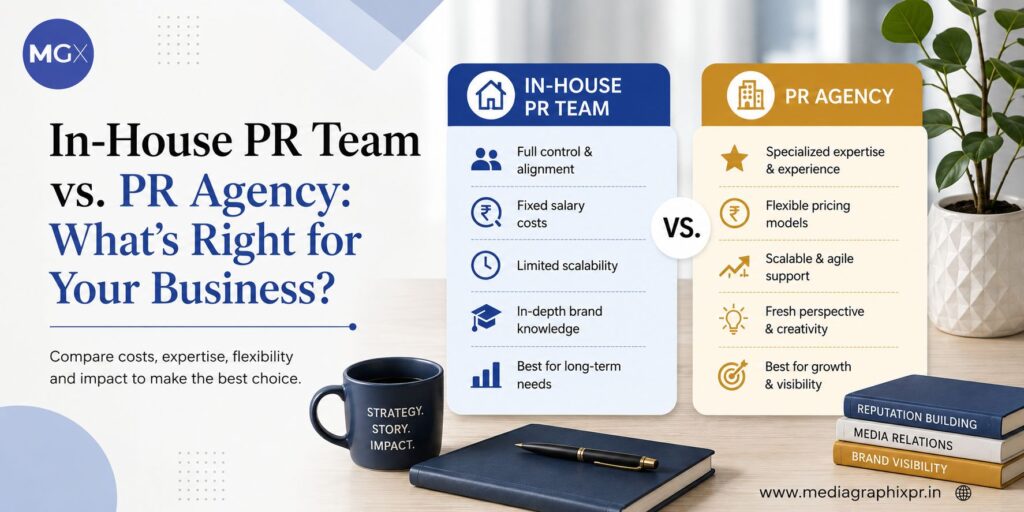
A founder hires a bright, enthusiastic communications manager, gives them a laptop and a LinkedIn login, and expects press coverage within the month. Three months later, there’s a handful of self-published LinkedIn posts, one small mention nobody outside the company noticed, and a growing sense that something about this isn’t working the way it was supposed to. It’s not that the hire wasn’t capable. It’s that the company mistook hiring a person for building an entire function, and those are two genuinely different things that get confused far more often than they should.
This is the exact confusion sitting underneath one of the most common decisions a growing business has to make: build PR in-house, or bring in an agency. Neither answer is universally right, whatever a LinkedIn post insisting otherwise might claim. An in-house team offers depth, focus, and total ownership of a single company’s story. An agency offers something an internal hire almost never can on day one, established relationships with the journalists who actually decide what gets covered. Getting this decision wrong doesn’t just waste a budget line, it wastes months of momentum a business won’t easily get back, which is why this is worth thinking through properly instead of defaulting to whichever option feels more familiar. MediagraphixPR walks nearly every prospective client through before signing anything, because the honest answer sometimes points away from an agency entirely, at least for now.
It’s also worth acknowledging why this question comes up at such an inconvenient time for most businesses, right when they’re already stretched thin managing product, sales, and hiring across every other function. There’s rarely a calm, unhurried moment to sit down and evaluate this properly, which is exactly why so many companies end up defaulting to whichever option a founder happens to have a personal opinion about, rather than working through what the business genuinely needs at its current size and stage.
This piece breaks down exactly what an in-house PR function actually requires to work, where agencies genuinely outperform internal teams, the hybrid model most growth-stage companies eventually land on, and a clear framework for figuring out which path actually fits a specific business at its specific stage.
What “In-House PR” Actually Requires to Work
Building a PR function inside a company sounds simpler than it is, mostly because the job looks like writing and pitching from the outside, when it’s actually built on relationships that take years to develop. Most founders underestimate this precisely because they’ve watched an agency or a senior communications person make it look effortless, without seeing the years of groundwork sitting behind that ease.
- A dedicated communications hire needs time before results show up. Building genuine journalist relationships from scratch typically takes six months to a year, even for a skilled hire, simply because trust with a reporter isn’t transferable from a resume.
- One person rarely covers every angle a business needs. Media relations, content, crisis response, and executive visibility each require slightly different skills, and a single in-house hire is usually strong in one or two, not all four.
- Internal hires often lack an existing media network on day one. Unlike an agency, a new communications hire typically starts with zero standing relationships with the specific journalists covering a company’s sector.
- The role can become isolating without senior mentorship. A junior or mid-level PR hire without an experienced person to learn from often plateaus quickly, repeating the same tactics without developing sharper instincts over time.
None of this means in-house PR doesn’t work. It means it works differently than most founders expect going in, and the businesses that succeed with it usually understand this before making the hire, not after.
Where an Agency Genuinely Outperforms an Internal Team
➤ Established Journalist Relationships
This is the single biggest advantage an agency brings on day one. A journalist who’s been taking an agency’s calls for a decade responds differently than one receiving a cold pitch from a brand-new in-house hire, and that difference shows up directly in coverage quality and speed.
➤ Multiple Specialists Instead of One Generalist
An agency retainer typically includes access to people who specialize in media relations, crisis communication, content strategy, and executive positioning, rather than expecting one internal hire to be strong across all of it simultaneously.
➤ Immediate Capacity Without a Hiring Process
Building an in-house team takes months of recruiting, onboarding, and ramp-up time. An agency engagement can start delivering within weeks, which matters considerably for a business facing a near-term milestone like a funding round or product launch.
➤ Objectivity During Difficult Moments
An external partner can push back on messaging that sounds good internally but reads poorly externally, something an internal hire, especially a junior one reporting directly to the founder, often finds harder to do. That outside distance also tends to matter most during exactly the moments a business can least afford a misstep, a product recall, a leadership change, or a piece of unflattering coverage that needs a calm, considered response rather than a defensive one.
Where an In-House Team Genuinely Outperforms an Agency
- Deep, undivided focus on a single company. An in-house hire’s entire job is understanding one business intimately, while an agency inevitably splits attention across multiple client accounts.
- Faster internal coordination. Someone sitting inside the company can move quickly on same-day opportunities, internal announcements, or fast-moving situations without the back-and-forth an external partner sometimes requires.
- Stronger institutional memory. An in-house hire accumulates context about the company’s history, culture, and past messaging decisions in a way that’s harder for a rotating agency team to fully replicate.
- Lower cost at a meaningful scale. For a company that eventually needs constant, high-volume communications output, a well-built internal team can become more cost-efficient than an agency retainer over the long run.
Comparing the Two Models Side by Side
| Factor | In-House Team | PR Agency |
|---|---|---|
| Time to First Results | Slower, typically six months or more, to build relationships. | Faster, often within weeks, due to existing journalist access. |
| Cost Structure | Salary, benefits, and tools, fixed regardless of output volume. | Retainer scaled to scope, often more flexible to adjust. |
| Media Relationships | Built from scratch; it takes years to mature. | Already established and immediately usable. |
| Range of Expertise | Usually one or two specialisms per hire. | Multiple specialists across media, crisis, content, and strategy. |
| Company-Specific Depth | Very high, with full-time focus on one business. | Divided across an agency’s full client roster. |
| Flexibility to Scale Up or Down | Harder, tied to hiring and layoffs. | Easier, as the retainer scope can adjust more readily. |
The Hybrid Model Most Growth-Stage Companies Eventually Choose
It’s rarely a strict either-or decision in practice. Many growth-stage companies land somewhere in between, and the sequence usually looks something like this:
Early stage: founder handles PR personally or leans on an agency for narrative building
↓
Growth stage: an agency continues managing media relations and journalist outreach
↓
An internal communications hire joins to manage day-to-day coordination and content
↓
The internal hire and agency work together; the agency owns media relationships, and the internal hire owns internal alignment and speed
↓
Later stage: a larger internal team forms, often still supported by an agency for specialized needs like crisis response or analyst relations
This hybrid structure tends to outperform either extreme because it combines an agency’s external relationships with an internal hire’s deep, focused understanding of the business. Companies that try to skip straight to a fully internal function too early often struggle precisely because the journalist relationships an agency brings simply can’t be rebuilt overnight by a new hire, no matter how talented. The reverse mistake happens too, companies that stay purely agency-dependent long after they’ve reached a size where an internal hire would genuinely pay for itself, simply because nobody stopped to reassess the arrangement as the business grew.
Signs You’re Leaning Toward the Wrong Model for Your Stage
- You’ve hired an in-house person expecting agency-level media relationships within the first few months. That timeline mismatch is one of the most common reasons in-house PR gets judged unfairly as “not working.”
- You’re paying for a large agency retainer but only need occasional, project-based support. A smaller, project-based engagement often makes more sense than a full retainer for a business with infrequent PR needs.
- Your in-house hire is stretched across media relations, content, events, and crisis response simultaneously. That’s typically three or four different jobs being asked of one person, and burnout or shallow execution usually follows.
- You chose an agency purely because a competitor uses one, without assessing your own actual PR needs. Following a competitor’s structure without evaluating fit often leads to paying for capabilities that aren’t actually being used.
- You keep extending an agency retainer month after month without a clear sense of what’s actually being delivered. That vagueness is usually a sign the scope was never clearly defined in the first place, not necessarily a sign the agency itself is underperforming.
This last pattern comes up more often than founders expect, businesses stuck with a mismatch between what they’re paying for and what they actually need, unsure whether the fix is switching models entirely or simply rescoping what they have. MediagraphixPR works through exactly this kind of assessment with businesses regularly, whether that conversation ends in a full retainer, a lighter project engagement, or honest advice to build internally first and revisit later, and can be reached directly at +91 9999148748 or business@mediagraphixpr.in by anyone trying to work out which model actually fits where their business is right now.
Questions Worth Asking Before Deciding
Before committing to either path, it helps to answer these honestly:
- Does the business have a near-term milestone, like a funding round or launch, that needs fast, credible media access? That timeline usually favors an agency over a slower-to-ramp internal hire.
- Is the need ongoing and high-volume, or occasional and project-based? Constant, sustained output often justifies in-house investment eventually; occasional needs rarely do.
- Does the founder or leadership team have bandwidth to manage an internal hire closely during their ramp-up period? Internal hires without senior guidance tend to plateau faster.
- Is the industry one where existing journalist relationships matter disproportionately, like fintech or BFSI? Regulated or complex sectors often benefit more from an agency’s established access than a general consumer business might, since trust and accuracy carry more weight in how those stories get pitched and covered.
Building the Right Structure, Not Just Picking a Side
This exact decision, in-house versus agency versus a hybrid of both, is something MediagraphixPR has walked founders through for 25 years, often recommending an approach that isn’t the one generating the agency the most revenue upfront, because a mismatched engagement rarely lasts and never actually serves the client well. Our approach to PR strategy consulting starts by understanding a business’s actual stage, industry complexity, and near-term milestones before recommending any specific structure.
For companies that do need an agency partner, our media relations work across national business dailies, sector-specific trade publications, and regional outlets means clients get the journalist access an internal hire typically can’t build for years. For companies better served by a hybrid model, our fractional PR support works alongside an internal communications hire, handling media relationships and strategic positioning while the internal team manages day-to-day coordination and institutional knowledge. Either way, the goal stays the same: a structure genuinely built around what the business needs, not around whichever engagement happens to be easiest to sell.
If you’re currently unsure whether your business needs an in-house hire, an agency, or some combination of both, that uncertainty itself is usually a sign worth exploring properly before committing budget in either direction.
FAQs
At what company size does it typically make sense to build an in-house PR team?
There’s no fixed employee count, but companies with consistent, high-volume communications needs, frequent product launches, ongoing executive visibility, or regular investor updates tend to see the strongest return on an internal hire once that volume becomes sustained rather than occasional.
Can a single in-house PR hire realistically handle everything a growing company needs?
Rarely, beyond a certain point. One person can usually manage either media relations or content and internal coordination well, but expecting strong performance across media relations, crisis response, content, and executive positioning simultaneously often leads to shallow execution across all of them.
How long does it typically take an in-house PR hire to start generating meaningful media coverage?
Somewhere between six months and a year, honestly, because journalist relationships just don’t build any faster than that no matter how good the hire is. If a business is expecting agency-level speed from someone who started three weeks ago, that expectation is the problem, not the hire.
Is it common for companies to switch from an agency to an in-house team, or vice versa?
It happens all the time, really, as a business’s needs shift. Plenty of early-stage companies start out with an agency because it gets them faster access, then build up their own internal team once volume picks up. Some go the other way too, usually when an internal hire leaves and the company suddenly needs coverage without a gap.
Does working with an agency mean a business shouldn’t have any internal communications point of contact?
Not at all. The agency engagements that actually work well almost always have at least one person inside the company handling approvals, giving context, and keeping messaging consistent, even if that person isn’t the one pitching journalists directly.
What’s a reasonable first step for a business that’s genuinely unsure which model fits?
Starting with a shorter, project-based agency engagement, rather than a long-term retainer or a full-time hire, often gives a business real signal about its actual PR needs and volume before committing to a bigger, harder-to-reverse structural decision.
The Structure Matters More Than the Label You Put On It
Whether PR lives inside the company, outside it, or somewhere in between isn’t really the question that matters most. What matters is whether the structure actually matches what the business needs to communicate right now and whether it’s resourced properly enough to actually deliver on that. Businesses that get this fit right early tend to spend far less time second-guessing the arrangement later on, which frees up energy for actually building the coverage and credibility the structure was meant to produce in the first place.
MediagraphixPR has spent 25 years helping businesses figure out exactly that, sometimes as the agency running the program, sometimes as the partner supporting an internal team, and sometimes as the honest voice saying an internal hire makes more sense for now. For a closer look at how we approach this decision with clients, visit our PR consulting services or write to us directly at business@mediagraphixpr.in or call +91 9999148748 to talk through what actually fits your business, honestly, before you commit budget or headcount to either direction.