Two startups launch in the same month, selling nearly identical products, with nearly identical ad budgets behind them from day one. Six months later, one is still explaining to every prospect who they even are. The other closes deals faster, hires more easily, and just recently raised a round investors were genuinely competing to get into. Same spend on ads. Wildly different trajectory. The difference wasn’t the underlying product itself. It was that one of them built something ads alone can never buy: genuine third-party credibility that made every single dollar of ad spend afterward work considerably harder than it otherwise would have.
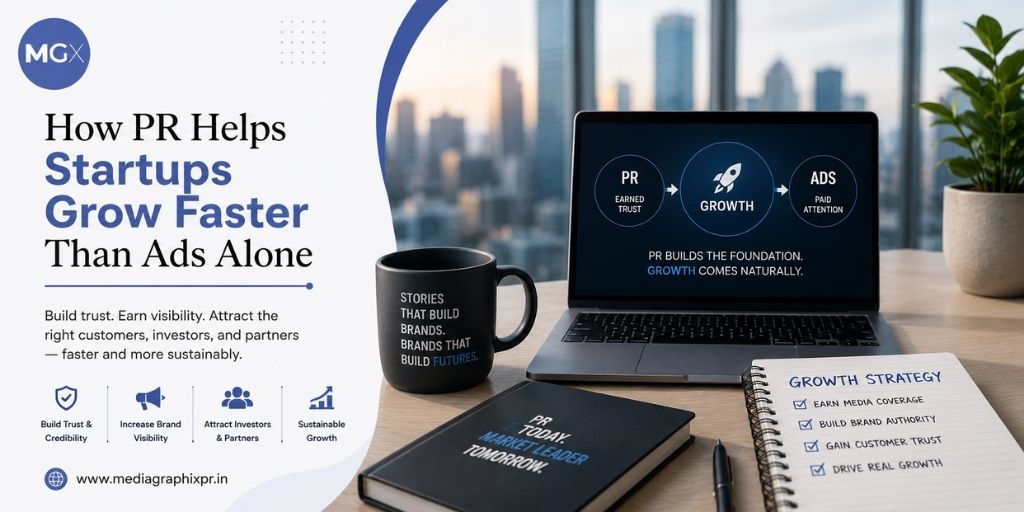
This is the part most early-stage founders genuinely miss when they’re deciding where the first serious marketing rupee actually goes. Ads are fast, visible, and easy to measure, which makes them the obvious first move. But ads alone hit a ceiling quickly, because an advertisement, no matter how clever, is still just a business talking about itself. PR works differently. It earns validation from people with no financial stake in the outcome, journalists, analysts, and industry voices, and that validation compounds in a way paid visibility structurally can’t. This piece breaks down exactly how PR helps startups grow faster than an ads-only strategy ever could, the specific benefits of PR for startups that show up in investor conversations, hiring, and sales cycles, and how the two functions, done right, actually accelerate each other rather than compete for the same limited budget. This is precisely the compounding effect MediagraphixPR has watched play out across hundreds of founder engagements, where the startups building credibility early consistently outpace the ones pouring everything into paid visibility alone.
It’s worth naming why this particular mistake is so easy to make, even for genuinely sharp founders. Ad platforms hand you a dashboard, impressions, clicks, conversions, and a number that updates in real time and feels concrete enough to defend in a board meeting. PR doesn’t offer that same immediate feedback loop, which makes it feel riskier even when it’s actually building something more durable underneath the surface. That mismatch between what feels measurable and what actually moves a business forward is exactly where so many startups end up over-indexing on ads for far longer than makes sense.
Why Ads Alone Have a Growth Ceiling
Advertising is genuinely effective at what it’s built for, driving immediate, trackable action. But it runs into a structural limit that PR doesn’t share.
- Ads are discounted by the audience almost automatically. Everyone knows an advertisement is paid content, which means the message starts from a position of built-in skepticism rather than trust before a single word of it is even read.
- Ad spend has to keep flowing continuously to keep working at all. The moment the budget stops, the visibility stops right along with it, and no residual credibility carries forward into the next quarter.
- Ads can’t build the kind of validation investors and enterprise buyers are actually looking for. A sophisticated buyer doing due diligence isn’t swayed by a company’s own advertising; they’re swayed by what independent, unaffiliated sources say about it instead.
- Repetition eventually breeds fatigue rather than trust. An audience that sees the same paid message repeatedly tends to tune it out entirely rather than believe it more with each additional exposure to the campaign.
- Ads have nothing to say when the news genuinely isn’t good. An advertisement can only ever say positive things about a business, which means it offers zero credibility buffer during a difficult moment, unlike a reputation built through years of honest, earned coverage that’s weathered scrutiny before.
What PR Actually Adds That Ads Structurally Can’t
➤ Third-Party Validation That Genuinely Compounds Over Time
Every piece of earned coverage becomes part of a startup’s permanent public record, discoverable by the next journalist, investor, or customer doing research, unlike an ad campaign that disappears entirely the moment spend stops flowing.
➤ Investor Confidence Before the Pitch Meeting Even Starts
Investors research founders and companies extensively before ever taking a call, and a startup with credible, consistent media presence starts that research process from a position of trust rather than having to build it from zero in the room during the actual meeting.
➤ Faster, Shorter Enterprise Sales Cycles
A buyer who’s already encountered a startup credibly in the press spends less time on basic trust-building during a sales conversation, moving faster to the actual value discussion instead of re-litigating whether the vendor is even legitimate.
➤ A Considerably Stronger Employer Brand for Hiring
Candidates increasingly research companies before accepting offers, and visible, credible media presence makes a startup a considerably more attractive place to join than one with zero public footprint anyone can actually find.
➤ Resilience When Something Goes Wrong
A startup with existing journalist relationships and an established reputation navigates a difficult moment, a product issue, or a controversy considerably better than one with no prior credibility to draw on, since a reservoir of earned trust absorbs a shock that would sink a brand-new, unknown company.
The Compounding Effect PR Builds That Ads Simply Don’t
Here’s the mechanism that actually explains why PR-led startups tend to outpace ads-only competitors over time, a loop that gets stronger with every cycle rather than resetting each time:
First credible placement earns coverage in a relevant publication
↓
That placement gets discovered by the next journalist researching the space
↓
The founder gets quoted again, building recognizable, repeated credibility
↓
Investors and enterprise buyers researching the company find consistent validation
↓
That validation reduces friction in fundraising and sales conversations
↓
Faster deals and easier hiring free up resources to invest further in growth
↓
Each new milestone becomes another opportunity for coverage, restarting the loop
Advertising doesn’t build this loop. Every campaign starts back at zero, buying attention fresh each time rather than compounding credibility that makes the next conversation easier than the last one, no matter how many rounds of budget get poured into it.
Where Ads Still Matter, and Why the Combination Wins
None of this means startups should abandon advertising entirely. Ads remain genuinely effective for immediate, trackable conversion, a product launch, a limited-time offer, direct response campaigns with clear ROI. The mistake isn’t using ads. It’s using ads as the only growth lever while ignoring the credibility foundation that makes those ads perform considerably better once it exists, since an audience that already trusts a brand converts more readily on the exact same ad spend.
| Scenario | Ads Alone | PR Alone | PR + Ads Together |
|---|---|---|---|
| Immediate product launch conversion | Strong, fast, trackable | Slower to show direct sales impact | Ads convert immediate interest; PR-driven credibility improves conversion rates |
| Investor fundraising conversations | Minimal direct impact | Builds pre-existing trust before pitch meetings | PR builds credibility; ads rarely factor into investor decisions at all |
| Enterprise sales cycle | Limited credibility impact | Reduces buyer skepticism significantly | Shorter sales cycles as ads generate leads PR has already made receptive |
| Brand recall over time | Fades once the spend stops | Builds lasting, discoverable credibility | Ads reinforce awareness; PR ensures that awareness translates into trust |
The Specific Startup Growth Moments Where PR Makes the Biggest Difference
- Before a funding round starts moving toward a close. Investors doing due diligence encounter a startup’s public credibility well before any term sheet conversation, and that research shapes the entire negotiation from the start of the process.
- During a category-defining launch moment. A startup trying to establish itself as the definitive player in a new or emerging space needs the third-party validation press coverage provides, something an ad campaign simply can’t replicate on its own.
- When hiring senior talent for critical roles. Experienced candidates evaluating multiple offers often factor in a company’s public reputation and momentum, something visible media coverage builds far more effectively than a careers page or a job listing ever could on its own.
- Entering a new market or geography. A startup expanding into an unfamiliar market benefits enormously from earned credibility that reduces the “who even are you” hesitation a cold ad campaign can’t overcome on its own.
- Following a difficult or genuine crisis moment. A startup rebuilding trust after something went publicly wrong needs the kind of credible, third-party validation that a rebranded ad campaign alone rarely restores convincingly, no matter how polished the messaging is.
Why Founders Delay PR, and Why That Delay Costs More Than It Saves
Founders often push PR to “later,” reasoning that ads deliver faster, more measurable short-term results, and PR feels harder to justify on a spreadsheet in the early days. That reasoning misses the compounding nature of credibility. A startup that starts building a genuine media presence early is in a fundamentally different position by the time it actually needs that credibility, a fundraise, a hiring push, or a competitive market entry than one scrambling to build it from scratch the week it’s suddenly needed. This is exactly the gap MediagraphixPR sees most often among founders who eventually do reach out, having spent a year or more on ads alone and hit a ceiling that no amount of additional ad spend seems to break through. It’s rarely too late to start, but every month spent purely on ads is a month of compounding credibility a competitor might already be building instead. MediagraphixPR works through exactly this transition with founders regularly and can be reached directly at +91 99991 48748 or business@mediagraphixpr.in by any startup that’s been running ads hard but still feels like nobody credible actually knows who they are or what they’ve built.
A Quick Self-Check for Where Your Startup Actually Stands
Go through these honestly, rather than assuming the growth you’re currently seeing will keep scaling the same way indefinitely:
☐ If an investor searched your company name today, would they find independent, credible coverage, or just your own website and ads?
☐ Does your sales team spend the first few conversations building basic credibility before discussing actual value?
☐ Have you noticed candidates asking questions that suggest they’d never heard of your company before the interview?
☐ Is your current growth entirely and precariously dependent on ad spend continuing at the same level just to sustain it?
☐ Could your business genuinely survive a difficult public moment right now with the media relationships and reputation you currently have in place?
If most of these point to gaps, that’s usually a sign the growth ceiling ads alone create is closer than it might currently feel, and worth addressing before it starts showing up in slower fundraising or hiring conversations.
Building the Credibility Layer That Makes Every Other Growth Lever Work Harder
This exact principle, credibility as the foundation that makes every other growth investment perform better, is what MediagraphixPR has built its startup practice around across 25 years in the industry. As an established PR agency in Delhi working with founders across sectors and stages, our approach to startup PR focuses specifically on the credibility milestones that actually move a business forward, investor-ready narrative building, founder visibility, and media relationships that compound over the life of the company rather than resetting with every new campaign that runs.
Our work spans funding announcement PR that turns a raise into lasting visibility rather than a single day’s headline, founder and executive profiling that builds the individual credibility increasingly outperforming generic brand messaging, and ongoing media relations across the national and sector-specific publications your actual investors, buyers, and future hires are reading right now, not just publications with impressive readership numbers on paper. If your startup has been running hard on ads and hitting a growth ceiling that more spend simply doesn’t seem to fix, that’s usually a credibility gap sitting underneath, not an ad performance problem that better targeting could ever solve.
FAQs
Should an early-stage startup with a very limited marketing budget prioritize PR or advertising first?
It really comes down to what you’re chasing right now. Trying to build credibility ahead of a fundraise? PR tends to stretch a rupee further there. Need to move product and see numbers move on a dashboard fast? Ads will usually get you there quicker in the short run.
How long does it typically take for PR to start showing a measurable impact on a startup’s overall growth?
Give it three to six months before expecting anything meaningful. Credibility builds slowly, it’s not something that shows up overnight the way an ad campaign does, and that’s exactly why so many founders underrate what PR actually does for a company in its early years.
Can a startup genuinely measure PR’s impact on growth as precisely as it measures ad performance?
Not with the same direct metrics, but meaningful signals do exist, branded search volume increases, investor and sales team feedback referencing coverage, inbound interest without active pitching, and shorter sales cycles are all measurable indicators that PR is genuinely working behind the scenes.
Does PR help more with B2B startups specifically, or consumer-facing startups?
Both, just in different ways. A B2B startup usually notices it most when enterprise sales cycles start moving faster and investor conversations get a little easier. Consumer startups feel it more through trust building up over time, general awareness, and customer acquisition costs slowly coming down.
Is it realistic for a startup to run PR and advertising simultaneously right from day one?
Mostly comes down to budget. Startups with real funding behind them can usually run both at once without much trouble. Early-stage startups working with less tend to do better sequencing it, building credibility through PR first before putting serious money into ads.
What’s the most common mistake startups make when they finally do decide to invest seriously in PR?
Treating it as a short-term campaign rather than a sustained effort. PR that runs for a single quarter and then stops rarely builds the kind of compounding credibility that actually changes investor, buyer, or hiring conversations, which requires consistency over many months, not a single push followed by silence.
The Startups Building Credibility Early Are the Ones Still Standing Out Later
Ads can make a startup visible today. Only credibility, earned consistently over time, makes that visibility actually mean something to the investor, buyer, or candidate deciding whether to trust the business behind it. That’s the distinction most ad-only strategies never quite close and the one that ends up separating startups that plateau from the ones that keep compounding.
MediagraphixPR has spent 25 years helping startups build exactly that kind of compounding credibility across India, working alongside founders through every stage from first press mention to sustained category leadership. For a closer look at how our startup PR work is structured, visit our startup PR page or write to us directly at business@mediagraphixpr.in or call +91 99991 48748 to talk through what your startup genuinely needs to grow past the ceiling ads alone can’t break through.