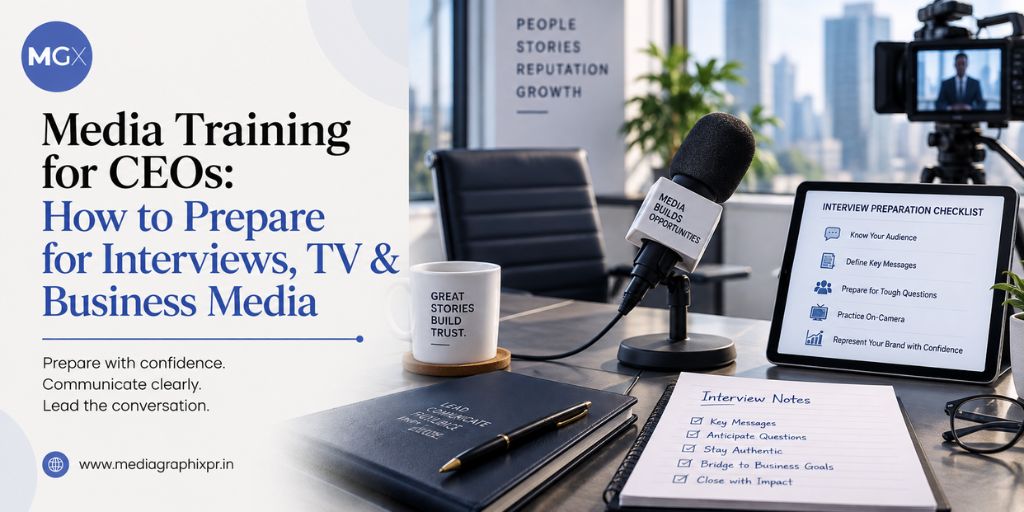
A CEO once sat down for what he assumed was a routine business channel segment, softball questions about quarterly numbers, and maybe a line about expansion plans. Four minutes in, the anchor pivoted without warning and asked him directly why his company’s biggest competitor had just poached two of his senior leadership team in the same month. He froze on live television for a beat that felt like ten seconds, said something vague and defensive, and by the time markets opened the next morning, his stock had moved on a story that was never actually about the leadership exits; it was about how badly he’d handled the question. That single unscripted moment did more damage than any actual business problem the company was facing that quarter, and it happened purely because nobody had rehearsed him for the question that mattered most.
This is exactly the risk sitting underneath every CEO interview that hasn’t been properly prepared for, and it’s precisely why media training for CEOs has stopped being optional for any leader who’s expected to speak publicly on behalf of a company they lead. MediagraphixPR has spent twenty-five years sitting across from executives before exactly these moments, watching which habits hold up under a hostile follow-up question and which ones fall apart the instant a script gets abandoned. This piece breaks down what genuinely effective preparation for interviews, TV, and business media actually involves, why a CEO’s stakes are structurally different from a junior spokesperson’s, and the specific skills worth building before the next camera ever turns on.
Quick Answer: Media training for CEOs prepares executives to handle interviews, live TV appearances, and business press with composure, message discipline, and the ability to field unexpected or hostile questions without damaging the company’s stock price, reputation, or investor confidence. It covers message anchoring, on-camera presence, handling follow-up questions that stray from the agreed topic, and recovering cleanly from a misstep in real time. Unlike general spokesperson coaching, CEO-specific training accounts for the fact that a leader’s words can move markets within minutes, which raises the stakes of every single interview considerably higher than a routine company spokesperson faces.
Why a CEO’s Media Exposure Carries a Different Kind of Risk
A junior spokesperson misspeaking creates a correction. A CEO misspeaking creates a headline, sometimes a stock movement, occasionally a board conversation nobody wanted to have, and rarely a problem that resolves itself quietly.
Everything a CEO says gets read as company policy, even an offhand remark, which means there’s no such thing as a truly casual comment once the camera is rolling.
Financial media specifically listens closely for anything that sounds like guidance. An imprecise comment about growth or performance can be interpreted as forward-looking guidance a company never actually intended to give.
Investors and analysts watch CEO interviews as closely as journalists do. A hesitant or evasive answer reads as a red flag to anyone tracking the company’s stock, regardless of what was actually said.
A CEO represents the entire leadership team in a single appearance. One shaky answer can undermine confidence in a company’s broader management team, not just the individual speaking on camera.
TV, Print, and Podcast Interviews Each Need Different Preparation
Not every media format carries the same risk profile, and treating every single one identically is one of the most common mistakes executives and their teams make when preparing for a single, unified media strategy that doesn’t actually account for the format’s specific demands.
| Format | What Makes It Different | What Preparation Needs to Cover |
|---|---|---|
| Live TV | No editing, no second take, body language visible throughout | Composure under pressure, concise answers, on-camera presence |
| Recorded TV | Some editing possible, but soundbites get selected from the full conversation | Staying on message throughout, since any single sentence could become the clip used |
| Print and digital | Quotes can be taken slightly out of context, tone doesn’t carry through text | Precision in language, since there’s no vocal tone to soften a sharp-sounding line |
| Podcast and long-form | Extended, conversational format that can lower guard over time | Sustained message discipline across a much longer conversation than a typical interview |
What Happens Without Proper Preparation, Step by Step
Understanding this sequence explains exactly why the damage from one bad interview spreads so quickly and why the cost of skipping preparation is almost always higher than the time it would have taken to prepare properly.
A CEO agrees to an interview without a clear sense of the likely questions
↓
An unexpected question lands, often a genuinely reasonable one the CEO simply wasn’t ready for
↓
The response comes out hesitant, defensive, or vague under the pressure of the moment
↓
That specific moment becomes the clip or the quote that gets shared and replayed
↓
Investors, employees, and competitors all encounter that exact moment, not the rest of the interview
↓
The company spends the following days managing a narrative that was never really about the original story
Real Media Training for CEOs, Step by Step
Preparation for a genuinely difficult interview isn’t built in a single session; it’s built through a sequence of deliberate steps that each address a different part of what actually goes wrong under pressure.
Step One: Lock the Three Messages That Actually Matter. Before any interview, a CEO needs three clear points genuinely worth communicating, not a script to memorize, but an anchor to return to no matter where the conversation drifts.
Step Two: Practice the Question Nobody Wants to Ask. The single most useful preparation exercise is rehearsing the toughest, most uncomfortable question a journalist could reasonably raise, since that’s exactly the one most likely to actually come up, and the one a CEO’s own team is usually most reluctant to raise honestly in advance.
Step Three: Rehearse Under Real-Time Pressure. Reading through likely questions on paper doesn’t prepare anyone for the pace of a live exchange. Genuine rehearsal happens out loud, in real time, ideally on camera.
Step Four: Learn to Bridge Without Sounding Evasive. Redirecting a question back toward a prepared message is a skill that takes practice to do smoothly; since done poorly, it reads as dodging rather than genuine communication.
Step Five: Build Comfort With Silence. A brief pause before answering a hard question reads as thoughtful on camera. Most untrained executives fill that silence with the first thing that comes to mind, which is often the wrong thing.
Step Six: Debrief After Every Real Interview. Reviewing what worked and what didn’t after an actual appearance is what turns one difficult moment into genuine, lasting improvement rather than a mistake repeated the next time, since the specific pattern that trips up a particular CEO rarely changes on its own without that deliberate reflection.
On-Camera Presence Checklist
Beyond what gets said, how it’s delivered on camera shapes the audience’s impression just as much, sometimes more.
- Maintain steady eye contact with the interviewer, not the camera lens, unless specifically directed otherwise by the production team.
- Keep answers to roughly twenty to thirty seconds for broadcast, since longer responses get cut awkwardly or lose the viewer entirely.
- Avoid crossed arms or closed body language, which reads as defensive even when the actual words being said are perfectly calm.
- Pause before answering a genuinely difficult question, rather than rushing to fill silence with an unconsidered response.
- Correct a misstatement calmly and immediately, rather than letting an inaccurate comment stand uncorrected on the record.
The Mistakes That Show Up Most Often in CEO Interviews
Even experienced, articulate executives fall into the same handful of avoidable traps repeatedly, often precisely because they’re used to being the most prepared person in every other room they walk into.
| The Mistake | Why It Backfires |
|---|---|
| Treating every interview as low-stakes because the topic feels routine | The most damaging moments often come from questions nobody expected, precisely because nobody prepared for a “routine” segment |
| Over-explaining instead of answering directly | Long, winding answers give a journalist more material to selectively quote from |
| Getting visibly defensive at a tough question | A hard question isn’t automatically hostile, and defensiveness reads worse than the question itself ever would |
| Speaking in absolutes about the future | A specific promise about growth or timelines can become the exact thing a business journalist checks back on later |
| Skipping rehearsal because the CEO “knows the business well” | Deep business knowledge doesn’t automatically translate into composure under an unscripted, high-pressure question |
This exact pattern, a CEO who genuinely understands the business but has never rehearsed handling an unscripted, high-pressure question, is one of the most common and entirely preventable causes of a damaging interview moment. If your leadership team has an upcoming appearance and hasn’t gone through structured preparation, MediagraphixPR works through exactly this kind of readiness with executives regularly, well before the next interview is already on the calendar.
CEO Media Training vs. General Spokesperson Coaching
Not every executive interview carries the same weight, and the preparation shouldn’t be identical across every role either. CEO media training specifically accounts for the fact that a chief executive’s words can move a stock price, shift investor sentiment, or set the tone for an entire organization’s public standing within minutes of airing. Executive media training more broadly covers senior leadership beyond the CEO role, department heads, founders, or C-suite executives who occasionally face media but don’t carry quite the same market-moving weight a CEO’s comments do.
That distinction matters when structuring a preparation program for a leadership team. A CEO typically needs deeper rehearsal around investor-sensitive language and forward-looking statements specifically, while broader spokesperson training across a leadership team might focus more on general message consistency and crisis readiness across multiple potential speakers who may never face the same market-moving scrutiny a chief executive does.
Why This Matters More During a Crisis Than Any Other Time
A CEO who’s never been through media interview training is at their most exposed during exactly the moment a company can least afford it, a crisis, a controversy, or a sudden piece of unfavorable news breaking without any warning. Composure that’s been rehearsed in advance holds up considerably better under real pressure than composure a CEO is hoping to find in the moment itself, when the stakes are highest and the room offers no time to think things through calmly. This is why the strongest PR media training programs don’t wait for a crisis to begin preparation, they build the underlying skill well before it’s ever actually tested on live television or in front of a business journalist with a hard question ready.
Building the Kind of Composure That Holds Up on Camera
This is exactly the discipline MediagraphixPR has built into every executive preparation engagement across twenty-five years in the industry, understanding that no two CEOs walk into an interview with the same level of natural comfort in front of a camera. As an established PR agency in Delhi, our approach to media training for CEOs starts with understanding a CEO’s specific sector, the questions they’re genuinely likely to face, and the tone their company needs to project, rather than running every executive through an identical generic script that ignores what actually makes their situation different.
Our work spans mock interviews built around real, sector-specific scenarios, on-camera coaching for broadcast appearances, and crisis-readiness preparation for leaders heading into a genuinely high-stakes conversation, paired with ongoing executive profiling that builds the kind of public presence a well-prepared CEO can actually carry into every future interview with confidence, long after the initial training session itself has ended.
FAQs
1. How far in advance of a scheduled interview should media training for CEOs happen?
Ideally at least a week before a major appearance, though even a focused session a day or two prior can meaningfully change how an interview goes. Ongoing training well before any specific interview is scheduled builds skills that hold up regardless of timing.
2. Is media training only necessary for a CEO’s first major interview?
No. Even experienced executives benefit from regular refreshers, since business conditions, company narratives, and the specific risks a CEO needs to navigate shift constantly, and complacency after early success is a common, often overlooked cause of later missteps that catch a well-established leader off guard.
3. What’s the biggest difference between preparing for print versus live TV?
Live TV leaves no room for editing or a second attempt, and body language becomes part of the message, while print interviews allow more precision in wording but carry the risk of a quote being read without the tone it was actually said in, which can make a genuinely reasonable comment sound far harsher on the page than it did out loud.
4. Can a CEO recover credibly after a genuinely bad interview moment?
Yes, though it takes deliberate follow-up rather than hoping the moment simply fades on its own. A calm, direct clarification issued promptly after a misstep tends to land far better than silence, and a well-handled recovery can sometimes build more credibility than a flawless interview would have in the first place.
5. Does media training help with investor calls as well as press interviews?
Yes, considerably. The same core skills, message discipline, composure under pressure, and precise language around forward-looking statements, apply directly to earnings calls and investor-facing conversations, not just traditional press interviews, since an analyst’s follow-up question can be every bit as unpredictable as a journalist’s.
6. How is media training for CEOs different from general public speaking coaching?
Public speaking coaching typically focuses on presentation skills for a controlled setting, while media training specifically prepares a leader for the unpredictable, adversarial dynamic of a journalist’s questioning, including hostile follow-ups and unscripted moments a prepared speech never has to account for.
The Composure a CEO Shows on Camera Is Rarely Accidental
The executives who come across as calm, credible, and genuinely in command during a difficult interview almost always got there through deliberate preparation, not natural talent alone. The ones who freeze, ramble, or get defensive are usually just as capable, they simply never rehearsed the moment before it actually arrived, and by the time they realize the gap, the clip has already been shared far wider than the original interview ever reached.
MediagraphixPR has spent twenty-five years providing media training for CEOs and preparing leaders for exactly this moment, before the camera starts rolling, not after a difficult clip has already spread across every platform imaginable. For a closer look at how our media training works, visit our media training services page, or write to us directly at business@mediagraphixpr.in or call +91 99991 48748 to get your leadership team ready before the next interview is already on the calendar.