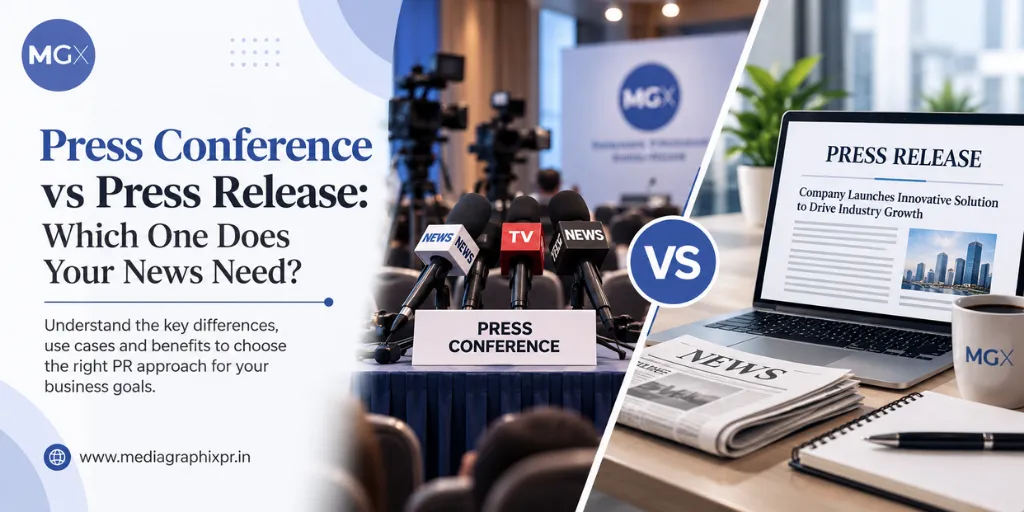
Your CEO has just walked out of a board meeting with big news, and within ten minutes you’ll hear three different instructions. Send a press note. Call a press meet. Post it on LinkedIn and see what happens. Each one can work, and each one can quietly waste a good story. Choosing between them is what the press conference vs press release question is really about, and it’s a decision MediagraphixPR has helped brands make for twenty-five years.
A press release is a written announcement sent to journalists, usually one page long, that lets them read the news on their own time. A press conference is a live briefing where speakers make the announcement in person and take questions. The release is cheaper, faster, and fully under your control. The conference is slower and riskier, but it gives reporters something a document can’t: a person to question. Neither is better in general. The right choice depends on how big the news is, how much explaining it needs, and whether reporters will want to challenge it. This guide covers the real differences, how Indian newsrooms use the terms, five signs your news is big enough for a room, when a written note does the job better, and how to use both without doubling your workload.
Press Conference vs Press Release: The Real Differences
Most people compare these two on cost alone. That misses most of what matters. Here’s how they actually differ in practice.
- A press release gives you control. You decide every word, and nothing can be misquoted in the room.
- It reaches many journalists at once, on their schedule.
- It leaves a clean written record that reporters can quote accurately.
- It can’t answer a follow-up question, so anything unclear stays unclear.
- A press conference gives reporters access. They can question your speakers directly, which builds trust when answers are honest.
- TV and photo desks get visuals and short soundbites, which a document can’t provide.
- It lets journalists meet the people behind the company, which a release never does.
- It costs far more in time and planning, and you can’t control which questions come.
Here’s the comparison in one place.
| Press Release | Press Conference | |
|---|---|---|
| Format | Written, usually one page | Live, usually 45 to 60 minutes |
| Effort and cost | Low | High |
| Control over message | Complex | Partial, because of Q&A |
| Reporter access to speakers | None | Direct |
| Best for | Clear, factual news | Big, complex, or sensitive news |
| Main risk | Gets ignored or skimmed | Low turnout or a hard question |
Press Meet vs Press Note: Why India Uses Different Words for the Same Choice
If you’ve worked with Indian newsrooms, you’ve heard both sets of terms. A press note usually means a short written release, often a page or less. A press meet usually means a live gathering of reporters. They overlap with press releases and press conferences, and most journalists will understand either pair.
The press meet vs press note distinction matters in one place: your invitation. If you write “press note” when you mean a gathering or “press meet” when you only plan to email a document, you’ll confuse the people you’re trying to reach. Be plain about what you’re offering and what reporters are being asked to do.
Whichever words you use, the underlying choice stays the same. You’re deciding between a document and a room.
When to Hold a Press Conference: Five Signs the News Is Big Enough
Knowing when to hold a press conference saves you from the most common mistake in this field, which is calling reporters out for news that never needed them. Look for these five signs.
- The news will raise questions. A merger, a leadership exit, or a safety issue will produce questions that a document can’t answer.
- Many people are affected. News that touches customers, employees, or the public tends to deserve a conversation, not just a notice.
- There’s something to show. A new facility, product, or technology gives TV and photo desks a reason to attend.
- Several voices need to be heard. A partnership between companies, or between a company and an institution, works better when everyone is in the room.
- Trust is at stake. In a crisis, facing reporters directly signals that you have nothing to hide.
If none of these apply, the room is probably unnecessary.
When a Press Release Is Enough (or Better)
Plenty of news is better served by a clean written note. A conference for these would waste everyone’s time.
- Routine updates, such as new hires, awards, and small partnerships.
- Product features and service changes that readers can understand without a demo.
- Reports and research findings that reporters will want to read carefully and quote.
- Event announcements, where the details matter more than the discussion.
- Clarifications or corrections, where speed and accuracy matter more than a performance.
A release also works when you want wide pickup. Sending one to a carefully chosen list often reaches more reporters than any room could hold.
Which One Does Your News Need? A Quick Decision Path
Use this flowchart when you’re stuck. Start at Step 1 and follow the instruction that matches your answer.
PRESS RELEASE OR PRESS CONFERENCE?
Step 1: Is there real news?
→ If NO: Skip both. Use a blog post or a social update instead.
→ If YES: Go to Step 2.
Step 2: Can the news be explained fully in writing?
→ If YES: Go to Step 3.
→ If NO: Go to Step 4.
Step 3: Will reporters want to question someone about it?
→ If NO: Send a press release. Your work is done.
→ If YES: Go to Step 4.
Step 4: Is the news big enough to justify a room? (Think about the five signs earlier in this guide.)
→ If NO: Send a press release, and offer one-on-one calls to key reporters.
→ If YES: Go to Step 5.
Step 5: Hold a press conference, and send a press release alongside it.
Matching Common News to the Right Format
Here are some real situations and the format that usually suits them.
| Your News | Best Choice | Why |
|---|---|---|
| Large funding round or acquisition | Press conference plus release | Reporters will have questions about the deal |
| New CEO or major leadership change | Press release, or a conference if the change is sudden | Sudden changes invite questions |
| Product launch with a live demo | Press conference plus release | Visuals matter for TV and photo desks |
| Award or recognition | Press release | Nothing to question |
| Crisis or safety issue | Press release plus written statement | Trust depends on facing questions |
| Annual report or survey results | Press release, with optional briefings | Reporters need time with the data |
Using Both Together Without Doubling the Work
The best announcements treat the release and the conference as partners. The release is the permanent, accurate record. The conference is the live moment that earns attention. Here’s a simple way to combine them.
USING BOTH TOGETHER
Step 1: Write the press release first. (This locks in your facts, numbers, and quotes.)
↓
Step 2: Invite reporters to the press conference about a week ahead. (Mention that the release will be shared at the event.)
↓
Step 3: Prepare your speakers using the release as the single source of truth. (Everyone says the same thing, in their own words.)
↓
Step 4: Hand out or share the release as reporters arrive. (They can then focus on the questions, not on taking notes.)
↓
Step 5: Hold the press conference.
↓
Step 6: Send the release, photos, and quotes to everyone on your list within hours. (This includes reporters who couldn’t attend.)
Because the release is written first, the conference becomes easier to prepare, not harder.
How Reporters Actually Read Each One
It helps to see this from the other side of the desk, because reporters ask different questions of each format.
Reading a release, a journalist asks, “Can I use this today, and is it accurate?” Clear facts, a real quote, and a reachable contact decide the answer.
Deciding on a conference, the same journalist asks, “Is this worth leaving my desk?” Strong news, a credible speaker, and a sensible date decide that one.
Watching a conference, a TV reporter asks, “Do I have a clean soundbite and usable visuals?” Print reporters ask, “Did anyone say something I can quote?”
Understand those three questions and most of your decisions get easier.
Mistakes That Make Either Format Backfire
- Calling a conference for news that fits in a release. Reporters remember who wasted their morning.
- Sending a release for news that clearly needs questions. It can look like you’re avoiding the discussion.
- Burying the news in a long release. If it isn’t in the first two sentences, many readers never reach it.
- Skipping speaker preparation. A conference without rehearsal is a gamble with your reputation.
- Using the two formats in conflict. If the release says one thing and the speakers say another, reporters will notice.
- Forgetting follow-up. Both formats need personal contact afterward, and neither works well as a one-time blast.
Most of these mistakes come down to a weak list of reporters and a missing relationship. When brands don’t have either, the choice between formats gets made in the dark. That’s the gap MediagraphixPR fills, by matching the format to the news and the news to the right journalists.
How MediagraphixPR Helps You Choose and Execute
This is the discipline MediagraphixPR has built over twenty-five years, because the press conference vs press release decision is rarely about format alone. It’s about the news, the people covering it, and what you need to achieve. We start by asking what the announcement is supposed to accomplish, then recommend the lightest format that gets it done.
Our press conference work covers the full event, from planning and invites to speaker preparation and follow-up, while our media relations team makes sure the right reporters hear about it from someone they trust. Speakers get ready through our media training, and funding announcements are planned with our funding announcement PR experts. Our sector teams for startup PR, fintech PR, and healthcare PR know what reporters on each beat expect.
As an established PR agency in Delhi, we also plan announcements for clients across Mumbai, Bangalore, Noida, and Gurgaon, where newsroom habits differ from city to city.
If you’re deciding how to announce something right now, that’s the best time to ask for a second opinion, well before an invite or a draft exists.
FAQs
1. Does a press conference get more coverage than a press release?
Not automatically. A conference can produce deeper, more visual coverage when the news is strong, but a well-targeted release can reach more outlets at once. The quality of the news matters more than the format, and a conference for weak news often gets less attention than a good release.
2. Will newspapers print my press release exactly as written?
Rarely. Journalists usually rewrite, shorten, or combine releases with their own reporting, and many will only use the facts. Earned coverage and paid placement are different things, so don’t expect your wording to appear untouched unless you’ve bought the space.
3. What is an embargo, and should I use one?
Essentially, an embargo is you asking reporters to sit on a story until a specific date and time. It makes sense when journalists need extra time to prepare properly, say for a big announcement or a detailed report. Don’t lean on it too often, make sure everyone’s actually agreed to it before you share anything, and only ask it of reporters who’ve said yes to the arrangement.
4. Should I issue a press release in English only?
Not always. If your news matters to readers of Hindi or regional-language outlets, a translated version helps those reporters cover it accurately. Have a fluent speaker check the translation, since a literal one can distort the meaning.
5. How do the costs compare between a conference and a release?
A release costs mainly writing time and distribution, so it’s the lower-cost option. A conference adds venue, equipment, materials, refreshments, and staff time, and the total depends heavily on city and scale. Decide what the news is worth before choosing the format.
6. Can a small startup with a limited budget still get coverage?
Yes. A strong release sent to well-chosen reporters, followed by personal calls, often does more than an expensive event with a weak list. Save the room for moments when the news really needs one.
The Right Format Makes Good News Easier to Cover
Reporters don’t judge your announcement by how much you spent on it. They judge it by whether the format suited the news, and whether the people behind it were ready. Getting the press conference vs press release choice right early saves money, protects your reputation, and gives your story the best chance of being told accurately.
MediagraphixPR has spent twenty-five years helping brands make that choice well, before the announcement goes out, not after the wrong format has already cost them coverage. To talk through how we’d handle your next announcement, visit mediagraphixpr.in, write to business@mediagraphixpr.in, or call +91 99991 48748.