A startup closes a genuinely good round, the kind of number that should turn heads, and the announcement lands with a thud anyway. Twelve likes on LinkedIn. A press release nobody outside the company reads. Meanwhile, a competitor with a noticeably smaller round somehow ends up in three major publications and half of everyone’s feed for a week straight. The difference almost never comes down to the size of the check. It comes down to a handful of avoidable mistakes that quietly sabotage funding announcements before they even go live.
Here’s the uncomfortable truth about funding PR: most startups only announce a raise a handful of times in their entire journey, maybe three or four rounds total before an IPO or acquisition. That means founders rarely get the repetitions needed to learn what actually works through trial and error. Every mistake in this piece gets made fresh by a new founder every single week, not because they’re careless, but because nobody explains what actually moves a funding story from forgettable to genuinely newsworthy. This is exactly the gap MediagraphixPR exists to close, having sat through hundreds of these announcements and watched precisely where they go right and where they quietly fall apart. This piece breaks down the specific, recurring mistakes that undercut funding announcements, why each one happens, and exactly how proper PR fixes it before the story ever goes live.
It’s worth being upfront about why this particular moment is so unforgiving compared to other press opportunities a startup will have. A funding announcement is time-bound in a way most other stories aren’t; there’s a specific closing date, a limited window where the news genuinely feels current, and a small handful of chances to get the sequencing right. A product launch can be re-announced or reframed later if the first attempt underwhelms. A funding round largely can’t. Once that window closes, the story is essentially spent, which is exactly why the mistakes below carry more weight here than they might for other kinds of company news.
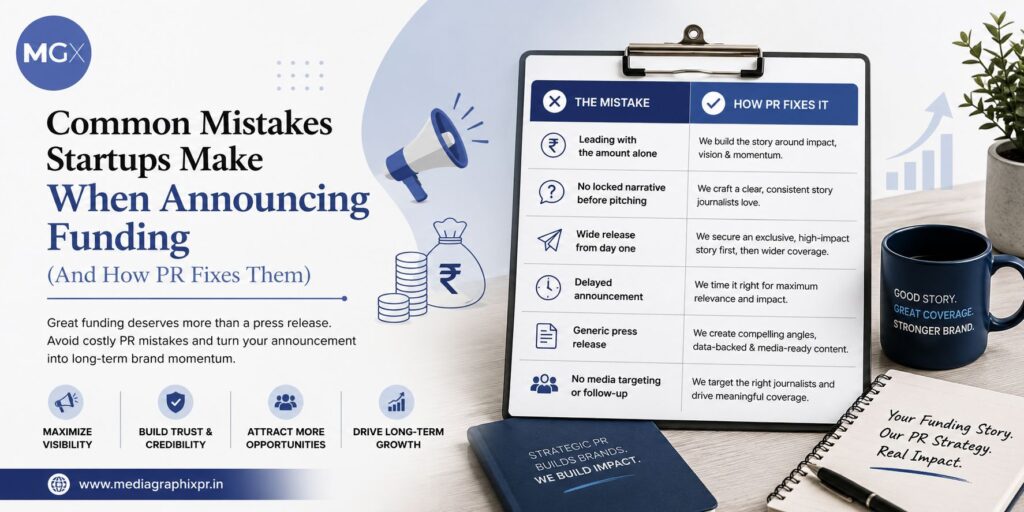
Mistake One: Treating the Amount as the Story
The Problem: Most founders lead with the number, assuming the size of the round is inherently interesting. Journalists see dozens of funding announcements weekly, and a number alone, however impressive, rarely justifies coverage on its own, no matter how many zeros are attached to it.
Why It Happens: The number is the easiest, most concrete part of the whole raise to point to, so it naturally starts to feel like the win itself, not just a detail of it. Founders understandably want to lead with what feels like the biggest win.
The Fix: A well-built funding story leads with what the money actually changes, market expansion, a new product line, aggressive hiring, and treats the amount as supporting context rather than the headline itself. Journalists cover change and momentum, not just capital sitting in a bank account.
Mistake Two: Announcing Without a Clear Narrative Locked In
The Problem: A lot of founders start calling journalists before they’ve actually figured out what the round means for where the company’s headed next, and that shows up as inconsistent pitches that different reporters end up interpreting in completely different ways.
Why It Happens: There’s genuine time pressure once a round closes, and narrative development can feel like a step that’s slowing things down when everyone just wants the news out.
The Fix: Locking the narrative first, what changes because of this money, in one clear sentence, gives every subsequent pitch, quote, and press release a consistent anchor. Every journalist encountering the story should walk away with the exact same understanding of why it matters, regardless of which outlet or angle brought them to it.
Mistake Three: Skipping the Exclusive and Going Wide From Day One
The Problem: Sending the same press release to every publication simultaneously often produces thin, press-release-style coverage rather than one strong, well-researched flagship story that other outlets then reference.
Why It Happens: Going wide just feels safer. More coverage volume seems like the better bet than fewer, deeper placements, especially when a founder is nervous the announcement might flop.
The Fix: Give one credible, relevant publication the exclusive first, with enough runway to actually research and write something worth reading, then follow up with the wider release. That builds a strong anchor story that smaller outlets and social shares end up building on, instead of ten near-identical pieces fighting over the same handful of readers.
Mistake Four: Waiting Too Long to Announce
The Problem: A round that closes quietly and only gets announced weeks or months later has lost most of its news value by then, since both journalists and readers respond to what feels current.
Why It Happens: Legal processes, investor sign-offs, and getting messaging aligned internally can genuinely push an announcement back, and PR planning often ends up at the bottom of the list until everything else is settled.
The Fix: Starting PR groundwork two to three weeks before the round is expected to close, in parallel with legal finalization rather than after it, means the announcement can go out close to when the round actually closes, while the news still feels current and worth a journalist’s time.
The Chain Reaction When These Mistakes Stack Together
It’s rarely just one mistake sinking a funding story. Usually it’s several compounding at once, each one making the next slightly worse, and here’s how that typically plays out from a founder’s perspective on the ground:
Round closes without a locked narrative
↓
Press release goes out wide to every publication simultaneously
↓
Coverage comes back thin, mostly rewritten press-release copy
↓
Founder goes quiet after day one, assuming the announcement is “done”
↓
Story disappears from relevance within 48 hours
↓
Next funding round starts from the same low baseline of visibility
Compare that to a startup that locks its narrative, secures a strong exclusive, and keeps the story building for two weeks afterward. The compounding effect works in the opposite direction entirely, each week’s activity reinforcing the last, building toward genuine, lasting visibility rather than a one-day spike.’
What Good Funding PR Actually Fixes, Side by Side
Seeing the mistakes and the fixes side by side makes the pattern easier to spot, and easier to catch before it repeats on the next round:
| The Mistake | What It Produces | What Proper PR Delivers Instead |
|---|---|---|
| Leading with the amount alone | A forgettable, generic headline | A story built around genuine change and momentum |
| No locked narrative before pitching | Inconsistent coverage across outlets | One clear, consistent story every journalist receives |
| Wide release from day one | Thin, press-release-style coverage | A strong exclusive anchor followed by broader pickup |
| Delayed announcement | Reduced news value and relevance | Timely news that lands while it’s still genuinely current |
| Silence after day one | A 48-hour spike that disappears | Sustained visibility through follow-up interviews and features |
Mistake Five: Ignoring Investor and Founder Quote Coordination
The Problem: Investors are often approached for quotes at the last minute, leading to generic, forgettable statements or delays that push the entire announcement timeline back.
Why It Happens: Investor communication frequently sits lower on a founder’s priority list during an already hectic closing period, and quote requests get treated as an afterthought.
The Fix: Reaching out to investors for quotes two to three weeks ahead, with specific guidance on what makes a quote genuinely useful, gives them time to provide something considered rather than a rushed, generic line that adds nothing to the story.
Mistake Six: Founders Going Silent Immediately After the Announcement
The Problem: The announcement gets treated as a finish line rather than a starting point, and momentum dies within 48 hours because nobody is doing anything to sustain it.
Why It Happens: There’s a natural instinct to relax once the big news is out, and founders often don’t realize follow-up visibility requires deliberate planning, not just waiting for more inbound interest to arrive on its own.
The Fix: A structured follow-up plan, founder interviews, byline articles, or podcast appearances scheduled for the one to two weeks after launch keeps the story building instead of letting it fade the moment the initial spike passes.
This exact pattern, a strong announcement day followed by total silence, is one of the most common and most fixable mistakes founders make, and it’s usually not because they don’t understand its importance; it’s simply that nobody on the team has the bandwidth to plan and execute follow-up coverage while also running the actual business. MediagraphixPR works through exactly this kind of post-announcement momentum planning with founders regularly and can be reached directly at +91 9999148748 or business@mediagraphixpr.in by anyone with a round closing soon who wants the story to actually last longer than the first news cycle allows.
Mistake Seven: Forgetting the Internal Audience Entirely
The Problem: Employees, existing customers, and vendors sometimes learn about a funding round from the news rather than from the company directly, which can feel careless and undermine internal trust right when morale should be at its highest.
Why It Happens: External PR planning naturally focuses outward, and internal communication can slip through the cracks amid the pressure of coordinating journalists and investors.
The Fix: A short internal note or all-hands update, timed to go out just before the public announcement, keeps the team feeling like insiders rather than bystanders discovering the news alongside everyone else. It costs almost nothing to plan and does more for internal trust than most founders expect going in, especially for employees who’ve been with the company through the harder stretches before the round closed.
The Founder’s Pre-Announcement Fix List
Before pitching a single journalist, a founder should be able to confirm each of the following is genuinely in place:
☐ A single, locked narrative everyone involved in the announcement is aligned on.
☐ Investor and founder quotes finalized, not rushed together at the last minute.
☐ A decision made on exclusive versus wide release, with a clear reason behind the choice.
☐ Visual assets ready, founder photos, logos, and product shots, prepared well before outreach begins.
☐ A follow-up content plan already scheduled for the two weeks after the announcement.
☐ Internal communication timed to reach employees and key stakeholders before the public news breaks.
Skipping even two or three of these consistently correlates with the same underwhelming outcome, a quiet news day, a scattering of thin coverage, and a story that’s forgotten within the week. None of these items are difficult individually; they simply require someone to actually own the sequence rather than assuming it’ll come together naturally once the round closes.
Building Funding Announcements That Actually Last
This entire list of mistakes and fixes is exactly what MediagraphixPR has built its funding announcement PR practice around over 25 years of managing raises for startups across India, from first-time seed rounds to late-stage rounds ahead of an IPO. As a dedicated funding announcement PR agency, the discipline isn’t treating a raise as a single press release moment, it’s building the sequence, the narrative, the exclusive, the follow-up, that turns a good round into a story that keeps generating conversations for weeks rather than fading by the following morning.
Our process covers everything this piece has walked through end to end: narrative development locked in advance, investor quote coordination handled with enough lead time to actually be useful, exclusive media placements with journalists who genuinely cover the startup funding beat, and a structured follow-up plan that keeps founders visible well past the first 24 hours after the news breaks. For startups working toward bigger milestones down the line, our startup PR and IPO communication expertise means the same team handling today’s seed announcement can carry that narrative forward through every subsequent round without the story ever feeling disjointed or having to start from scratch each time a new milestone comes around.
If your next round is on the horizon and you’d rather avoid becoming another quiet Tuesday announcement that disappears by Thursday afternoon, that planning needs to start well before the round actually closes.
FAQs
Can a startup fix a poorly announced funding round after the fact, or is the moment permanently and entirely lost?
The initial spike is gone, but a strong follow-up push, founder interviews, a byline article connecting the round to genuine business momentum, or a customer milestone announced shortly after, can rebuild some of the visibility a weak initial announcement missed.
How far in advance should investor quotes realistically be requested for a funding announcement?
Two to three weeks out is a good target. That gives investors real time to put together something specific and considered, rather than scrambling to send over a generic line the night before the story goes live.
Is it a genuine mistake to announce a funding round on the same day as a major industry news event?
More often than not, yes. If a funding story is competing with a much bigger news cycle that same day can get buried entirely, so checking the broader news calendar before locking in an announcement date is worth the extra step.
Should every funding round get the exact same level of PR investment, regardless of its overall size?
Not really. A smaller, earlier round tends to do better with a founder-led narrative and lighter outreach, whereas a bigger, later-stage round usually calls for the full exclusive-plus-wide-release approach with more follow-up built in.
What’s the single most common reason a funding announcement underperforms despite a genuinely strong, well-priced round?
Silence after day one. Even a genuinely well-run announcement day starts losing steam fast if there’s nothing planned to follow it up, no interviews, no founder visibility, nothing, and a strong start just quietly fades instead of building into something bigger.
Does a startup need a PR agency specifically for a funding announcement, or can it be handled entirely in-house without outside help?
It can be handled in-house, but the value an agency adds is usually in journalist relationships and lead time; an existing relationship with a relevant reporter often means the difference between a thoughtful exclusive story and a generic press release rewrite.
A Funding Round Only Tells the Story You Actually Build Around It
The size of a raise rarely determines how much attention it gets. The startups that get remembered are the ones that treated the announcement as a sequence worth planning properly, not a press release fired off the moment the wire transfer clears. That planning is almost always the actual differentiator, not the number sitting at the top of the term sheet.
MediagraphixPR, a trusted PR Agency in Delhi, has spent 25 years helping Indian startups avoid exactly the mistakes covered in this piece, turning funding news into lasting visibility instead of a single forgettable news cycle. For a closer look at how our funding announcement process works, visit our website or write to us directly at business@mediagraphixpr.in or call +91 9999148748. At the same time, there’s still time to plan your next announcement properly, rather than scrambling together a press release the week the round finally closes.