A patient’s family is standing in a hospital corridor at 2 AM, scared, exhausted, and deciding within minutes whether they trust the place their loved one is in right now. That decision was shaped long before that night, by a Google search done weeks earlier, a news article half-remembered, or something a neighbor said about the hospital’s reputation in passing. Nobody makes a healthcare decision in a vacuum. They make it standing on a foundation of trust that was built, or quietly eroded, well before they ever walked through the door.
That’s the entire reason hospitals, diagnostic chains, and healthcare brands in India need something most of them still treat as optional, real, deliberate PR. Not a marketing brochure. Not a paid ad campaign promising the “best doctors in the city.” Genuine third-party credibility, built through the same slow, earned process that works for any business, but carrying stakes that are considerably higher, because the product being trusted isn’t a service or a gadget; it’s someone’s health, sometimes someone’s life. This piece breaks down exactly what a healthcare PR agency does differently from a general PR firm, why hospitals specifically need this kind of specialised support, what genuinely good healthcare PR looks like in practice, and how a properly run health public relations agency, one that understands both media and medicine, changes the way patients, doctors, and regulators perceive an institution. MediagraphixPR has built real depth over the years, precisely because healthcare communication demands a level of accuracy and care that most general PR playbooks were never designed to handle.
It’s worth being honest about why so many hospitals still under-invest in this specifically. Healthcare administrators are, understandably, focused on clinical operations, staffing, and infrastructure, the things that most directly affect patient outcomes day to day. Communication often gets treated as a secondary function, handled reactively rather than built deliberately, right up until the moment a crisis makes the cost of that neglect painfully obvious. By then, rebuilding trust is a considerably harder, slower task than it would have been to build proactively in the first place.
Why Healthcare Communication Is Fundamentally Different
Most industries can afford a little exaggeration in their messaging. Healthcare genuinely cannot, and that single distinction shapes everything about how PR needs to work in this space, from the words a press release uses to the way a spokesperson is briefed before an interview.
- The stakes of inaccuracy are considerably higher. A misleading claim about a product feature is a marketing problem. A misleading claim about a treatment outcome can be a patient safety issue and potentially a legal one.
- Regulatory scrutiny is constant. Healthcare communication in India operates under specific advertising and ethics guidelines from medical councils and health authorities, which most general PR teams simply aren’t trained to navigate.
- Trust decisions carry emotional weight most purchases don’t. Choosing a hospital isn’t like choosing a restaurant. It’s often made under stress, fear, or urgency, which means the credibility signals a family relies on matter enormously.
- Doctors are the actual product, in a sense. Patients aren’t just evaluating a hospital’s infrastructure; they’re evaluating the expertise and trustworthiness of the specific physicians treating them, which shapes what PR actually needs to communicate.
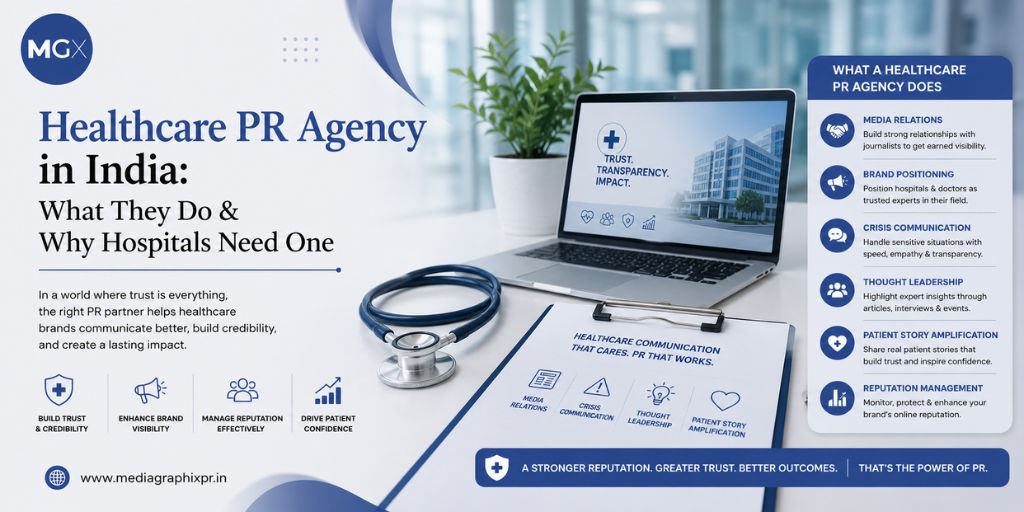
What a Healthcare PR Agency Actually Does
➥ Physician and Specialist Visibility
Positioning doctors and specialists as genuine experts through media commentary, bylined articles, and public health conversations, building the kind of individual credibility patients actively look for before choosing a specialist.
➥ Patient Trust and Reputation Building
Securing coverage that demonstrates a hospital’s genuine outcomes, technology, and patient care standards, communicated in a way that’s accurate and verifiable, not promotional.
➥ Regulatory and Ethical Compliance in Messaging
Ensuring every piece of communication, from a press release to a physician’s quoted comment, stays within the advertising and ethics guidelines healthcare institutions in India are bound by.
➥ Crisis and Reputation Management
Having a plan and existing media relationships ready before a difficult moment, a medical error, a public health scare, or an adverse outcome, rather than scrambling to build both while the story is already breaking.
➥ Public Health Awareness Campaigns
Positioning a hospital as a genuine community health resource through awareness campaigns, expert commentary during health crises, and educational content that serves the public first and the brand second.
➥ Investor and Stakeholder Communication
For healthcare businesses raising capital or expanding, PR plays a role in building the kind of credibility investors and partners look for before committing to a healthcare institution specifically, where trust and compliance history carry outsized weight.
Why Hospitals Specifically Need This, Not Generic PR
A generic PR agency can pitch a story. What it often can’t do is understand why a specific claim about a surgical outcome needs to be phrased with clinical precision, or why a hospital can’t simply call itself “the best” in a press release without running into ethics guideline issues that a general consumer brand would never have to think twice about.
Here’s roughly how patient trust actually forms and where healthcare PR fits into that sequence:
A patient or family faces a health concern
↓
They search online for the hospital or specialist being considered
↓
They find media coverage, doctor profiles, or public commentary, or they find nothing at all
↓
Credible coverage builds initial trust before a single conversation happens
↓
That trust shapes how confidently they proceed with treatment decisions
↓
A positive experience, communicated well afterward, builds trust for the next patient in the same position
A hospital absent from that sequence, no credible coverage, no visible physician expertise, isn’t automatically distrusted, but it’s asking every patient to make a significant, often frightening decision purely on word of mouth or a glossy website, without any independent validation along the way to reassure them they’re making the right choice.
The Specific Risks of Getting Healthcare PR Wrong
- Overpromising outcomes. Any communication that implies a guaranteed result, a “success rate” without proper context, or language that overstates a treatment’s certainty, creates both an ethical problem and a potential legal liability.
- Inconsistent messaging across doctors and departments. When different specialists within the same hospital describe the institution’s capabilities differently in public, it quietly undermines the credibility of all of them.
- Reactive, unprepared crisis response. A hospital without existing journalist relationships or a crisis communication plan is significantly more exposed when something goes wrong publicly, an adverse event, a complaint that goes viral, or a regulatory inquiry.
- Treating every doctor the same in visibility efforts. Not every specialist wants or needs the same level of public profile, and a one-size-fits-all approach to physician visibility often produces awkward, ineffective media appearances.
- Copying language from competitor hospitals without scrutiny. Borrowing phrasing that sounds impressive from a rival institution’s website or press release, without checking whether it’s actually defensible for your own outcomes and data, is a quiet but common way inaccurate claims end up in a hospital’s own communications.
This is precisely where a lot of hospitals in India quietly struggle, either avoiding PR altogether out of caution, which leaves them invisible exactly when patients are searching for trust signals, or handling it in-house without the specific sector expertise that keeps messaging both compelling and compliant. Both extremes leave the same gap behind: a hospital that may genuinely have excellent outcomes and skilled physicians, but nothing credible for a searching family to actually find. MediagraphixPR works through exactly this balance with healthcare clients regularly, and can be reached directly at +91 9999148748 or business@mediagraphixpr.in by any hospital or healthcare brand unsure whether their current communication approach is actually serving patients or quietly putting the institution at risk.
What Good Healthcare PR Actually Looks Like in Practice
Seeing the difference clearly, what genuinely works against what tends to backfire, makes it easier for a hospital communications team to catch a misstep before it goes public rather than after:
| Area | What Works | What Backfires |
|---|---|---|
| Physician Visibility | Genuine expert commentary during relevant health news cycles | Forced, overly promotional profiles that read as self-serving |
| Patient Outcome Communication | Accurate, contextualized data with appropriate caveats | Vague “success rate” claims without supporting context |
| Crisis Response | A calm, transparent, fact-based statement issued quickly | Silence, or a defensive statement that reads as evasive |
| Public Health Campaigns | Genuinely educational content that builds community trust | Awareness campaigns that feel like thinly veiled advertising |
| Media Relationships | Ongoing, consistent engagement with health and science journalists | One-off pitches sent only when the hospital needs coverage |
Building Trust Before the Crisis, Not During It
Healthcare institutions face a particular kind of reputational risk that most other sectors don’t encounter at the same frequency; a single adverse event, however rare, can become a public story overnight. The hospitals that navigate these moments credibly are almost always the ones that had journalist relationships and a response plan in place well before anything went wrong, rather than trying to build both from scratch under pressure.
☐ Establish media relationships proactively, not only when a story needs to be pitched or managed.
☐ Build a clear crisis communication protocol with pre-identified spokespeople trained to respond calmly and transparently.
☐ Keep physician messaging consistent across departments, so the hospital’s public story doesn’t contradict itself from one specialist to the next.
☐ Review all patient-facing claims for regulatory compliance before they go out, not after a complaint or inquiry forces a correction.
☐ Maintain a steady rhythm of credible visibility, rather than going quiet for months and only surfacing during a crisis or a promotional push.
What Founders and Hospital Administrators Often Get Wrong
Even well-run hospitals sometimes approach PR the same way a consumer brand might, chasing volume, treating every announcement as newsworthy, or leaning too hard into promotional language that reads as inauthentic in a healthcare context. Health journalists, unlike general business reporters, are often deeply skeptical of promotional healthcare claims specifically because so much of what reaches their inbox overstates outcomes or exaggerates capabilities. A hospital that consistently communicates with accuracy and restraint tends to build far more durable credibility with both journalists and patients than one chasing the most dramatic possible headline. That restraint isn’t a limitation on good PR; it’s often exactly what makes healthcare coverage credible enough for a journalist to want to run it in the first place.
Twenty-Five Years of Understanding Where Medicine and Media Meet
This is exactly the specialized work MediagraphixPR has built within its broader PR practice, understanding that healthcare communication requires a fundamentally different level of accuracy, compliance awareness, and sensitivity than a typical consumer or B2B engagement. As a healthcare PR agency working with hospitals, diagnostic chains, and healthcare brands across India, our approach starts with understanding the specific regulatory and ethical constraints a healthcare institution operates under, then builds a communication strategy that’s genuinely compelling without ever crossing into language that misleads or overpromises. That balance, compelling but never careless, is where most general agencies stumble the moment they take on a healthcare client without the sector-specific grounding to get it right.
Our work as a health public relations agency spans physician thought leadership, patient trust campaigns, crisis preparedness specific to healthcare’s unique risks, and public health awareness initiatives that position hospitals as genuine community resources rather than purely commercial entities. We’ve built relationships with health and science journalists across national and regional publications who cover this space seriously, which means the coverage we secure for healthcare clients reaches the audiences that actually matter, patients making real decisions, not just readers scrolling past another press release on their way to something else.
If your hospital or healthcare brand has genuine expertise and outcomes that simply aren’t reflected in what patients find when they search for you, that gap is exactly what specialized healthcare PR exists to close.
FAQs
How is healthcare PR genuinely different from general hospital marketing or paid advertising?
Marketing and advertising are paid, brand-controlled messages, while PR earns third-party credibility through journalists and independent coverage. In healthcare, that earned credibility matters even more, since patients making high-stakes decisions tend to trust it far more than anything that reads as an ad.
Can a hospital’s in-house marketing team fully handle PR without any specialized healthcare PR expertise?
For basic tasks, sure. But healthcare PR calls for a genuine familiarity with medical advertising guidelines, ethics council regulations, and knowing exactly how to phrase clinical claims so they hold up, and most general marketing teams simply haven’t been trained for that specific layer of nuance.
How should a hospital respond publicly and quickly when a negative medical event becomes a news story?
Fast, honest, and never silent. Acknowledging what’s happened with a calm, fact-based statement, and committing clearly to a fuller response soon after, tends to protect credibility far better than staying quiet or sounding defensive.
Is it ethical or even advisable for hospitals to promote specific individual doctors publicly?
It is, as long as it’s done through genuine expert commentary and thoughtful, accurate positioning rather than promotional claims about outcomes. Patients look into individual specialists all the time, so visibility built on real credibility genuinely helps them make better-informed decisions.
Do smaller hospitals or standalone clinics actually need PR, or is it only relevant for large, well-established hospital chains?
Smaller providers often stand to gain the most, actually, precisely because they don’t have the built-in brand recognition that larger chains take for granted. Real, credible visibility can help a smaller hospital compete for patient trust even against much bigger, more established names.
How exactly does PR help a hospital during a public health crisis, like a disease outbreak or a broader health emergency?
A hospital that’s already built real relationships with journalists, and has a credible public voice to begin with, is in a far better position to be seen as a trusted source of accurate information when a crisis hits. And that trust doesn’t just fade once the emergency passes, it tends to stick around.
Trust in Healthcare Is Never Given Freely, It’s Built One Credible Story at a Time
A hospital’s reputation isn’t decided by its infrastructure or its equipment alone. It’s decided by whether patients, families, and the wider community have genuine reasons to trust it before they ever need to. That trust is built quietly, over years of consistent, honest communication, and it’s spent quickly, sometimes in a single mishandled news cycle, which is exactly why it deserves the same deliberate investment a hospital already puts into its clinical standards.
MediagraphixPR has spent 25 years building exactly that kind of earned, credible trust for healthcare institutions across India, understanding both the medicine and the media closely enough to get the balance right. For a closer look at how our healthcare PR work is structured, visit our healthcare PR services page, or write to us directly at business@mediagraphixpr.in or call +91 9999148748 to talk through what your hospital or healthcare brand genuinely needs, and where the gaps in your current communication approach might be quietly costing you patient trust.