A founder once described choosing a PR agency as “picking a wedding photographer based on a five-minute phone call.” You’re trusting someone with something that matters enormously, your company’s entire public story, based on a pitch deck, a confident conversation, and a gut feeling. No trial run, no way to preview the actual work, just a bet that the polish in the room today will still be there six months from now. That’s exactly the discomfort every founder feels somewhere in the middle of agency shortlisting, and it’s exactly why this decision deserves a real framework instead of a hunch, however good that hunch might feel in the moment.
India’s startup ecosystem isn’t short on agencies claiming to be the right fit. Dozens of firms across Delhi, Bangalore, and Mumbai all show up with a nearly identical pitch about senior attention, strong media relationships, and proven results. What’s missing isn’t options; it’s a clear way to tell which agencies will genuinely move a startup’s story forward and which ones sound impressive in a meeting and quietly underdeliver once the ink is dry. This checklist exists to close exactly that gap: what actually matters when evaluating a PR agency for startups, the specific questions worth asking before signing anything, and the red flags that predict a disappointing engagement.
MediagraphixPR has spent twenty-five years being one of the more established names doing this work for founders across India, and as a PR agency in Delhi working with startups across sectors and stages, we’ve built this checklist around exactly the standard we hold ourselves to. It’s worth being honest about why this decision resists easy comparison shopping in the first place. Unlike most vendor decisions, where a product demo or a work sample gives a fairly reliable signal, PR gets sold almost entirely on relationships, judgment, and trust, none of which show up cleanly in a slide deck. A founder sitting through a confident pitch has no easy way to check whether an agency’s claimed journalist relationships are genuinely active or just a list of names collected over the years and never quite let go of. This checklist exists specifically to close that verification gap.
Why Startup PR Decisions Are Genuinely High-Stakes
This isn’t a decision founders should treat lightly, and here’s the reasoning behind why choosing the right PR agency for startups in India deserves real scrutiny rather than a decision made purely on how good a pitch meeting felt.
- Timing windows are narrow and don’t repeat. A funding announcement, a product launch, a category-defining moment—each has a limited window where the story genuinely matters, and a mismatched agency can waste that window entirely.
- Startup budgets can’t absorb a wasted retainer. Unlike an established company that can afford to experiment with vendors, an early-stage startup’s PR spend needs to actually work, since there’s rarely room to burn a few months on the wrong fit.
- Agency mistakes compound into investor and hiring conversations. Weak or inconsistent PR doesn’t just mean fewer headlines; it means investors and candidates finding less credibility when they research the company independently.
- Founders rarely get the reps to learn this by trial and error. Most founders hire a PR agency once or twice in their entire startup journey, which means there’s little accumulated experience to draw on compared to hiring for other functions.
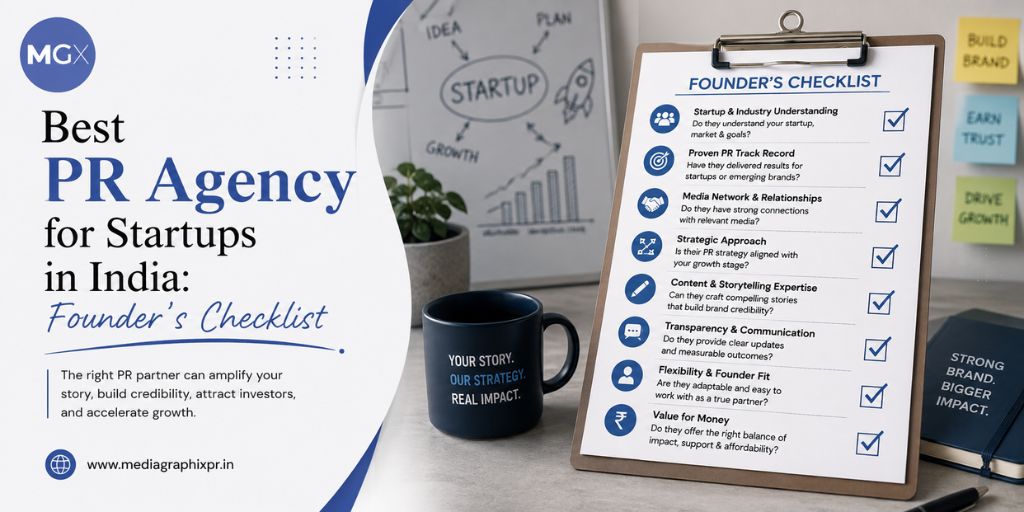
The Founder’s Evaluation Checklist
Work through this methodically before signing with anyone, rather than deciding purely on how confident a pitch felt in the room, since confidence and actual capability aren’t always the same thing.
☐ Ask for recent, verifiable placements specifically in your sector, not a broad portfolio spanning every industry the agency has ever touched.
☐ Request the names of journalists the agency currently works with relevant to your space, and gauge whether those relationships sound current rather than dated.
☐ Meet the actual team assigned to your account, not just the person who ran the pitch meeting.
☐ Ask what the first ninety days will look like, in specific terms. A vague “onboarding and strategy” answer usually signals the agency hasn’t done this rigorously before.
☐ Get clear on how success will actually be measured. Be wary of any agency that leans purely on clip counts instead of tying coverage back to something that actually matters for the business.
☐ Ask for references from startups at a similar stage and in a similar sector to yours. A generic reference list that has nothing to do with your situation doesn’t tell you much.
☐ Confirm what’s included in the retainer versus billed separately, covering things like event support, award submissions, or travel.
☐ Ask directly whether senior attention continues past the first few months, since account handoffs to junior staff are one of the most common sources of founder frustration later on.
What Genuinely Separates a Strong Startup PR Agency From a Good Pitch
A strong pitch and a strong agency aren’t automatically the same thing, and the gap between them usually only becomes visible after the contract is already signed. Here’s what actually separates the two before that point.
➜ Specificity Over General Claims
An agency that can name the exact journalists they’d approach for your specific story and explain why those particular reporters would care is fundamentally different from one that talks vaguely about “strong media relationships.”
➜ Sector Fluency, Not Just Sector Familiarity
There’s a meaningful difference between an agency that placed one story in your industry once and one that genuinely understands your buyers, your competitors, and the journalists who cover your specific beat.
➜ A Business Outcome Attached to Every Recommendation
Strong agencies start by asking what a startup actually needs to achieve, investor credibility, hiring support, and category leadership before proposing any tactics. Weaker ones start with a generic press release calendar regardless of the actual goal.
➜ Realistic Expectations Set Upfront
An agency promising major coverage within the first two weeks is usually either overpromising or planning to chase low-quality placements to hit that timeline artificially.
The Startup PR Evaluation Sequence
Rather than jumping straight from a pitch meeting to a signed contract, here’s roughly how the decision should actually flow, step by step, without skipping the parts that feel like they slow things down:
Shortlist three to five agencies based on genuine sector relevance
↓
Request specific, recent, verifiable placements from each
↓
Meet the actual day-to-day team, not just whoever led the pitch
↓
Ask each agency the same set of pointed questions, consistently
↓
Check references from startups similar in stage and sector
↓
Compare retainer scope in real detail, not just the headline number
↓
Consider a shorter, project-based engagement first if the fit still feels uncertain
Skipping straight from an impressive pitch to a signature is exactly how founders end up locked into a mismatched retainer they only recognize as a genuine mistake several payments in.
Red Flags Worth Taking Seriously
- Vague answers to pointed, specific questions. An agency that can’t name recent placements or a clear first ninety-day plan is often covering for a thinner track record than the pitch suggested.
- Pressure to sign quickly. A genuinely confident agency is usually comfortable with a founder taking time to compare options properly.
- Success is measured purely by coverage volume. Agencies fixated on clip counts rather than business outcomes often end up optimizing for the wrong thing entirely.
- No clear day-to-day point of contact. If it’s unclear who a founder will actually be talking to weekly, that ambiguity tends to persist well past signing.
- A broad but shallow client portfolio. Impressive-looking logos across every sector can signal a generalist approach rather than the depth that actually moves the needle for a specific startup.
- Reluctance to name who a founder will actually be working with day to day. If an agency keeps steering the conversation back to overall team credentials without naming a specific point of contact, that vagueness is rarely accidental.
This exact pattern trips up a lot of founders, choosing an agency on the strength of a confident pitch, only to find the promised senior attention quietly disappears a few months in. It’s rarely dishonesty on the agency’s part; more often it’s simply what happens when an agency takes on more accounts than its senior team can actually stay involved with. If that’s a situation you’ve experienced or want to avoid entirely, MediagraphixPR works through this evaluation with founders regularly and can be reached directly at +91 99991 48748 or business@mediagraphixpr.in by any founder comparing agencies right now and wanting an honest second opinion before committing.
What “Startup-Specific” PR Actually Requires
Not every capable PR agency is genuinely built for startups, and the difference matters more than founders often expect, particularly once the pace and unpredictability of early-stage company life actually kicks in.
| What to Check | Startup-Ready Agency | Poor Fit for Startups |
|---|---|---|
| Pace | Comfortable moving fast around funding rounds and launches | Processes built for slower, enterprise-style timelines |
| Founder involvement | Understands founders wear multiple hats and works around that | Expects the same bandwidth a corporate comms team would have |
| Budget structuring | Willing to scope engagements appropriately for early stage | Pushes a fixed, oversized retainer regardless of company size |
| Narrative approach | Comfortable building a story from limited traction | Requires significant existing scale before engaging seriously |
| Flexibility | Adjusts scope as the startup’s needs evolve quickly | Rigid engagement structure that doesn’t flex with fast-changing needs |
A Few Questions Worth Asking Before the Meeting Even Ends
Beyond the checklist itself, a handful of direct questions tend to reveal more than a polished pitch deck ever will. Ask an agency how they’d handle a founder who’s difficult to schedule for interviews, since that’s a genuinely common startup reality. Ask what happens if a planned announcement gets delayed internally, a frequent occurrence that a good agency should already have a process for. And ask, plainly, what a bad month with them typically looks like, because every agency has one eventually, and how they describe handling it tells you more than any success story would. The willingness to answer that last question honestly, rather than deflecting into another success anecdote, is itself a useful signal.
Twenty-Five Years of Building the Kind of Attention Founders Actually Need
This exact checklist, sector fluency, senior attention, and specific and verifiable relationships, are the standards MediagraphixPR holds its own work to across every founder engagement. As a dedicated PR agency for startups in India, our team doesn’t hand accounts off to junior staff after the pitch meeting ends; the same senior strategists who scope an engagement stay involved through month twelve and well beyond, which is exactly what most founders are hoping for and rarely get asked to verify upfront.
Our approach as a PR agency for startups starts by understanding the specific business outcome a founder needs, investor credibility ahead of a raise, category leadership in a crowded market, or hiring support during a growth push before proposing a single tactic. That’s paired with genuine, currently active media relationships across Economic Times, Mint, Business Standard, Forbes India, Inc42, and sector-specific publications, built and maintained consistently since 2000, not assembled hastily for a pitch and left to go cold the moment the contract is signed. Whether a founder needs support around a first funding announcement or an ongoing narrative-building retainer as the company scales, this checklist is exactly what we’d want any founder to hold us to as well.
If comparing agencies has started to feel like every pitch sounds identical to the last one, that difficulty itself is worth taking seriously before signing anything, rather than defaulting to whichever meeting happened to feel most reassuring in the moment.
FAQs
How many PR agencies should a founder realistically shortlist before actually making a decision?
Three to five is usually enough for a genuine comparison without the process dragging on for months. Meeting significantly more than that often just adds noise, since most credible agencies will present similarly strong pitches by that stage, making the extra meetings feel repetitive rather than genuinely clarifying.
Is a larger, more established agency always the safer choice for a startup compared to a boutique one?
Not necessarily. A bigger agency usually comes with more resources, but smaller accounts often end up getting less senior attention as a result. Boutique agencies, on the other hand, tend to stay closer to the founder and give more hands-on service. Which one actually fits depends on how much attention your startup genuinely needs right now, not on which name sounds bigger.
Should a startup be cautious if an agency insists on a long-term contract before starting any work at all?
It’s worth asking if there’s a shorter, project-based option or a trial period first. A lot of credible agencies build this in on purpose, so both sides can actually see if the fit works before locking into something longer that’s harder to back out of later.
How can a founder actually verify that an agency’s claimed media relationships are current and genuinely active?
Ask for recent placements, ideally within the last few months, and check whether those stories reflect genuinely earned coverage rather than sponsored content. Reviewing the agency’s actual recent client work tells a more accurate story than their case study slides alone, which are often built around a firm’s best moment from several years back.
What’s a reasonable early sign that a PR agency relationship isn’t working out the way it was expected to?
If senior attention noticeably drops after the first month or two, communication becomes inconsistent, or the coverage secured isn’t reaching audiences that genuinely matter to the business, those are worth raising directly with the agency before the engagement drifts further off track without either side addressing it.
Does the agency’s physical office location genuinely matter for startups based outside major cities like Delhi or Bangalore?
Less than founders often assume. An agency’s actual, current journalist relationships matter considerably more than its office address, and a well-connected national agency can serve a founder in a smaller city just as effectively as one physically based nearby, since most of the actual work happens over calls, email, and pitch calls rather than in-person meetings anyway.
The Right Agency Fit Beats the Most Polished Pitch, Every Time
Every agency in this space can put together a confident, well-rehearsed pitch. Far fewer can back that pitch up with the specific, current relationships and consistent senior attention that actually moves a founder’s story forward months into the engagement, not just in the first meeting. That’s exactly what this checklist is designed to reveal before a signature, rather than after several retainer payments have already gone out.
MediagraphixPR has spent 25 years being exactly the kind of agency that holds up against a checklist like this one, not just in the pitch, but also in the work that follows it long after the contract is signed. For a closer look at how we work with founders across India, visit our startup PR services page, or write to us directly at business@mediagraphixpr.in or call +91 99991 48748 to compare us honestly against whoever else is currently on your shortlist.