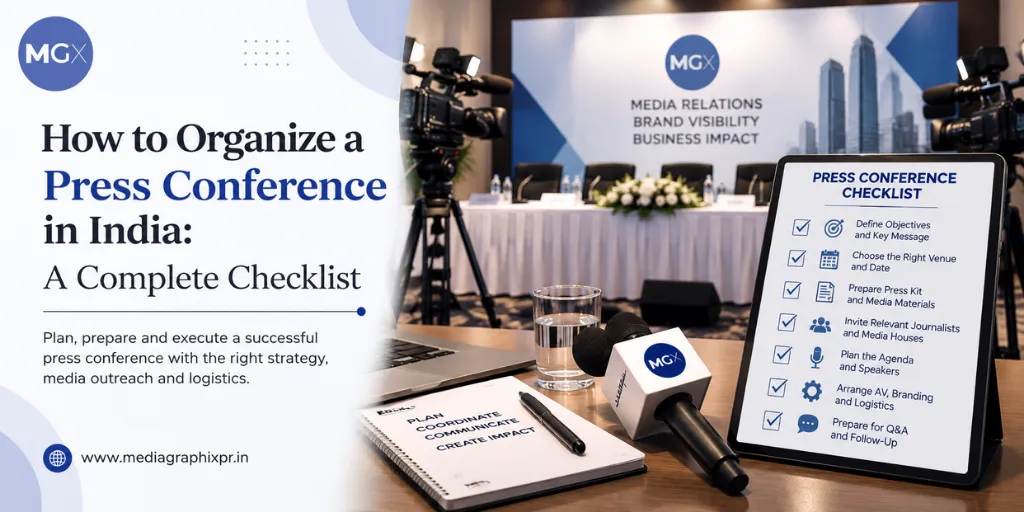
The founder had booked a banquet hall for 11 a.m., ordered lunch for sixty, and spent two weeks on a backdrop. At 11:20, the room held three journalists. Everyone else was across town at a rival announcement that nobody on the team had thought to check for. Knowing how to organize a press conference isn’t about the backdrop. It’s about the dozen small decisions made weeks earlier, and it’s exactly the planning MediagraphixPR has handled for brands over twenty-five years.
A press conference is a live briefing where a company, institution, or individual makes an announcement and takes questions from reporters, either in the same room or on the same call. It works when there’s real news, a clear speaker, and a room reporters actually want to be in. It fails when any one of those is missing. This guide covers the whole sequence in order: whether your news deserves a press conference at all, how to choose a date and venue, how to send an invite that gets a yes, how to prepare your speakers, what to confirm on the day, and what to do in the four hours afterward. It’s written for founders, marketing heads, and communications teams in India who’ve been handed the job and want a plan that works the first time.
When a Press Conference Is Worth Calling (and When It Isn’t)
A press conference asks journalists to give up an hour of a working day. That’s a real cost, and they’ll only pay it for news that can’t be handled with an email. The easiest test is simple: would a reporter rather hear this in person?
| Your News | Press Conference? | Better Option |
|---|---|---|
| A major funding round or acquisition | Yes, if the numbers are significant | A press release for smaller rounds |
| A new product or service launch | Yes, if it’s genuinely new to the market | Demo sessions or one-on-one briefings |
| A crisis, recall, or leadership change | Yes, when people need answers quickly | A written statement first, then a briefing if questions pile up |
| Original research or industry data | Yes, if the findings affect a wider sector | A report shared with chosen reporters |
| A minor feature update or small partnership | No | A press release or a short note to your key reporters |
| An anniversary or an award | No | A social post and a personal note to relevant reporters |
If most of your answers land in the “No” rows, a press conference will leave you with a half-empty room and a team wondering what went wrong. Save it for news that deserves the room.
How to Organize a Press Conference: The Six Stages in Order
Here’s how the work actually sequences, whether you’re running it in-house or with outside support.
Stage 1: News Check
→ Confirm the news is strong enough and write the single sentence it comes down to
↓
Stage 2: Date, Time, and Venue
→ Pick a weekday slot, check the news calendar for clashes, and book a place reporters can reach easily
↓
Stage 3: Media List and Invite
→ Build a targeted list and send an invite covering the who, what, when, where, and why
↓
Stage 4: Speaker Preparation
→ Lock the key messages and rehearse the hard questions
↓
Stage 5: The Event Itself
→ Run a tight program with a clear start, a clear Q&A, and time for one-on-ones
↓
Stage 6: Follow-Up
→ Send materials within hours, thank attendees, and brief the people who couldn’t come
Stage 1 is the one most teams skip. They book the venue first and then work backward, trying to find news that justifies the room. Starting with the news check keeps the rest of the plan honest. Late morning or mid afternoon on a weekday suits many newsrooms, but always check your date against the day’s major events before you commit.
Press Meet Planning: A Four-Week Countdown
Good press meet planning works backward from the event date. Each week has a job, and none of them can be squeezed into the last two days.
| When | What Needs to Happen |
|---|---|
| Four weeks before | Confirm the news, set the objective, choose speakers, and shortlist dates |
| Three weeks before | Check the date against major news and events, then book the venue and equipment |
| Two weeks before | Build the media list, draft the invite, and prepare the release and speaker notes |
| One week before | Send the invite, begin personal follow-up calls, and start speaker rehearsals |
| Two or three days before | Send a reminder, confirm RSVPs, and finalize the run sheet and seating |
| A day before | Hold a full rehearsal, test the equipment, and print signage and name tags |
| The day of | Arrive early, check everything again, and brief the whole team |
| Within four hours after | Send the materials, photos, and a thank-you note |
Press Conference Invite: What to Say and Who Gets It
A press conference invite has one job, which is to help a busy reporter decide quickly that attending is worth the trip. Include the news in one line, the speakers’ names and titles, the date, time, and venue with the nearest metro station, and a clear reason it matters to their readers. Add a name and phone number for RSVPs, and say what they’ll receive, whether that’s a release, photos, or one-on-one time with the speakers. Send it about a week ahead, then remind people two or three days out and again on the morning of the event.
Here’s a sample. Everything in it is fictional.
Subject: Invitation: Sahyadri Foods to announce its first plant outside Maharashtra, Thursday, 11:30 a.m., Mumbai
Dear [Name],
You’re invited to a press briefing where Sahyadri Foods will announce its first manufacturing plant outside Maharashtra, and what it means for jobs and prices in the packaged snacks category.
Speakers: Kavita Menon (Founder and CEO) and Rajesh Iyer (Head of Operations)
When: Thursday, [date], 11:30 a.m. The briefing runs about 45 minutes, and speakers will be available for one-on-one conversations afterward.
Where: [Venue], [city] (nearest metro: [station])
The release, photos, and fact sheet will be shared at the event and by email afterward. Please confirm your attendance with [name] at [phone].
Different reporters need different things from you, so tailor the follow-up call accordingly.
| Who You’re Inviting | What They Need From You |
|---|---|
| Print reporters | Quotes, data, and a chance to ask follow-up questions |
| TV channels | Clear visuals and speakers available for short bytes |
| Digital outlets | Fast access to the release, photos, and key numbers |
| Wire agencies | The release at the start of the event, and quotable lines |
| Photographers | A clear line of sight and a good backdrop |
Choosing a Venue Reporters Will Actually Travel To
In Delhi, Mumbai, Bangalore, and other large cities, traffic can decide your turnout more than your news does. Pick a place reporters can reach in reasonable time, and say exactly how to get there.
| Venue | Works Well For | Watch Out For |
|---|---|---|
| Press club | Wide reporter access and a neutral setting, common in cities like Delhi and Mumbai | Booking rules and limited slots, so confirm early |
| Hotel conference room | Larger events that need full audio and visual support | Cost, and a location that’s hard to reach in peak traffic |
| Your own office or plant | News tied to the place itself, such as a factory or a lab | Distance, parking, and a setting that can feel promotional |
| Online or hybrid | Reporters who can’t travel, and audiences across several cities | Weak connections and less engagement than a live room |
Local knowledge matters here. Teams planning events across Mumbai, Noida, and Gurgaon know which venues reporters actually attend and which ones they skip because of the commute.
Press Conference Checklist: Everything to Confirm Before the Day
Use this press conference checklist the day before, and again two hours before the start. Every item is there because someone once forgot it.
Venue and equipment
- ☐ The room is booked, with a backup contact at the venue
- ☐ A podium microphone and a spare are working
- ☐ The screen or projector is tested with your actual presentation file
- ☐ There are enough power points for cameras and laptops
- ☐ Wi-Fi details are ready to share with reporters
- ☐ The backdrop and signage are placed so they show up in photos
Content and speakers
- ☐ Every speaker has three key messages written down
- ☐ The run order is agreed and timed
- ☐ Tough questions have been rehearsed with honest answers
- ☐ The release, fact sheet, and photos are ready to share by link
Media handling
- ☐ A registration desk with a printed guest list and name tags is set up
- ☐ A team member is assigned to each TV crew and photographer
- ☐ A moderator will keep time and call on questions fairly
- ☐ Time is set aside for one-on-one interviews afterward
Comfort
- ☐ Seating covers the expected number plus a few extra
- ☐ Water, tea, and light snacks are arranged
- ☐ Directions and parking details are clear
- ☐ There’s a quiet corner for calls and for filing stories
Speakers, Questions, and the One You Hope Nobody Asks
Choose one lead speaker and, at most, one or two others with real expertise. Every extra speaker adds time and risk. Each of them should know the three messages they’re there to deliver and the order they’ll speak in.
Then rehearse the hard part. Reporters rarely ask what you’ve prepared for, so practice the questions that make people uncomfortable.
| The Question | What the Reporter Is Really Asking | How to Handle It |
|---|---|---|
| “Why now?” | Is this news, or a marketing exercise? | Give one concrete reason tied to a date or event |
| “What are the numbers?” | Can you back this up? | Share what you can verify, and say plainly what you can’t share |
| “What about your competitor?” | Will you stay calm under pressure? | Answer briefly, then return to your main message |
| “What if this fails?” | Are you being honest about the risk? | Acknowledge it and explain how you’re managing it |
This is the stage where structured media training changes the outcome, because rehearsing a hostile follow-up in a quiet room is far easier than meeting one on stage for the first time.
A Typical 60-Minute Run of Show
| Time | What Happens |
|---|---|
| 30 minutes before | Registration opens, and reporters receive the release and fact sheet |
| 0 minutes | The moderator welcomes everyone and introduces the speakers |
| 0 to 10 minutes | The lead speaker makes the announcement in plain language |
| 10 to 15 minutes | A second speaker adds detail or data |
| 15 to 40 minutes | Open Q&A, with the moderator calling on reporters in turn |
| 40 to 45 minutes | The moderator closes and thanks everyone |
| 45 to 60 minutes | Photos, TV bytes, and one-on-one interviews |
Keep the formal part under 45 minutes, because reporters have other stories to file. Start close to the time on the invite as well. Waiting for latecomers punishes the people who arrived on time.
The Four Hours After Decide How Much Coverage You Get
Most stories get filed within hours, so speed after the event matters as much as the event itself.
The event ends
↓
Within one hour: send the release, photos, and speaker quotes to everyone on the list
↓
Within two hours: share short video clips and key data with TV and digital desks
↓
Within four hours: send a personal thank-you to attendees, and a short summary to those who couldn’t come
↓
Next day: track coverage, answer follow-up questions quickly, and correct anything inaccurate
Mistakes That Empty the Room (or Waste It)
- Scheduling against bigger news. Check the day’s calendar before you lock the date, or you’ll compete with an announcement you can’t beat.
- Inviting everyone instead of the right people. A short list of reporters who cover your beat will outperform a long one every time.
- Calling a press conference without real news. Journalists remember who wasted their morning.
- Putting too many speakers on stage. Every additional voice stretches the program and dilutes the message.
- Letting speeches run long. If the Q&A starts after thirty minutes, you’ve already lost half the room.
- Skipping question rehearsal. The one question you didn’t prepare for is the one that becomes the headline.
- Using promotional language. Reporters want facts and context, not slogans.
- Linking hospitality to coverage. Tea and snacks are normal, but never offer anything in exchange for a story, because it damages your credibility and many newsrooms have strict rules against it.
Most of these problems trace back to two things: a weak media list and no personal follow-up. Both depend on relationships built long before an invite goes out, and that’s exactly the gap MediagraphixPR fills for brands that have the news but not the contacts.
How MediagraphixPR Plans Press Conferences Journalists Want to Attend
This is the discipline MediagraphixPR has built into every event over twenty-five years, because knowing how to organize a press conference is partly logistics and mostly relationships. A reporter decides whether to attend based on who’s inviting, how strong the news is, and whether the last event was worth the trip.
Our press conference work covers the whole sequence, from the news check and media list to the run sheet, speaker preparation, and follow-up. For funding announcements, the event is planned alongside our funding announcement PR work. Our sector teams for startup PR, fintech PR, and healthcare PR know which reporters cover each beat, and what each of them expects from a briefing.
As an established PR agency in Delhi, we also draw on years of media relations to make sure the right reporters hear about your event from someone they already trust.
If you’re planning an announcement and want a second opinion on the plan, that’s usually the best moment to talk to us, well before the venue is booked and the invites are drafted.
FAQs
1. How much does a press conference cost in India?
It varies widely with the city, the venue, the equipment, and the hospitality. Holding it at your own office can keep costs low, while a hotel hall with full audio and visual support costs considerably more. Budget for the venue, equipment, printing or digital materials, a photographer, and refreshments, then decide where you can scale back without hurting the experience.
2. Do journalists expect gifts or lunch at a press conference?
Tea, water, and light refreshments are standard, and a simple meal is common for longer events. Gifts are a different matter. Many newsrooms have rules against accepting them, and tying anything to coverage creates an ethical problem. Keep hospitality modest and never connect it to a story.
3. How many journalists should I invite?
Invite more than you expect to attend, because a good share of confirmed guests won’t make it on the day. Focus on quality over volume, with reporters who actually cover your sector, and use personal calls to firm up the ones who matter most.
4. Do I need a moderator?
Yes, especially if you have more than one speaker. A moderator keeps time, calls on reporters fairly, and steers the room back on track if a question runs long. It can be someone from your communications team, as long as they aren’t one of the speakers.
5. What should I do if only a few journalists show up?
Run the event as planned, but keep it shorter and more conversational. Then follow up with every invitee who didn’t attend, sending the release, photos, and an offer for a one-on-one call. A small, engaged room often produces better coverage than a crowded, distracted one.
6. Can we livestream the press conference on our own channels?
You can, and it’s a useful way to reach people who couldn’t attend. Just make sure reporters in the room still get priority, and that anything shared online matches what you’ve told them. Don’t release anything on your channels before the journalists have had the chance to file.
A Full Room Is Planned Weeks Before Anyone Walks In
The brands that fill a room with the right reporters rarely get lucky. They checked the news, picked the date carefully, sent a clear invite, prepared their speakers for the hard questions, and followed up fast. The ones facing an empty hall usually had a good announcement, and they simply started planning too late.
MediagraphixPR has spent twenty-five years showing brands how to organize a press conference that earns real coverage, before the announcement goes out, not after the room has emptied. For a closer look at how we plan events for your sector, visit mediagraphixpr.in, write to business@mediagraphixpr.in, or call +91 99991 48748 to get your next announcement ready.